Executive Summary
Fast fashion has become an important part of American pop culture and entertainment. It has given consumers the opportunity to participate in trends for a cheap price, but a small price tag in stores has come at a great cost elsewhere. Workers in factories are treated inhumanely, forced to work long hours, paid low wages, and are put in dangerous situations. It is vital that these labor abuses are taken with the utmost seriousness and addressed to uphold the law, preserve the economy, and protect the humanity and rights of workers.
Overview
Fast fashion is defined in Merriam Webster dictionary as “an approach to the design, creation, and marketing of clothing fashions that emphasizes making fashion trends quickly and cheaply available to consumers.” Fast fashion became popular in the late 1990s, as it became a form of entertainment and recreation. People were able to engage in popular trends for a cheap price. This meant trends were short lived, clothes were cheap, and companies had to keep up with a much faster cycle of production.
Though the term was coined in the ‘90s, the practices and concept behind the industry began in the 1970s when companies began running production in Asian countries for cheaper labor and lenient regulations. The fast fashion industry boomed in the 1990s, as the industry mastered the model for production for short-lived trends. Fast Fashion has only become more popular since then, and as trends have become shorter, people have been throwing away clothes at astronomical rates. In fact, brands like H&M have up to 52 micro-seasons a year, whereas it used to be 4 seasons a year. There has also been a 400% increase in the number of clothes consumed over the last twenty years.
To keep up with this level of mass production and keep prices cheap, companies had to cut costs. This often meant paying low wages to workers, not spending on factory conditions, moving abroad to countries with lenient labor regulations, and using subsidiaries to absolve themselves of responsibility.. These moves ensured that production was quick and cheap. Dangerous working conditions, low wages, and child labor are all exploited to make factories as productive as possible with little regard for human welfare.
Firstly, factories can pose major threats to the health and safety of workers. Fast fashion clothing production uses 8000 different synthetic chemicals, some of which are known to cause cancer. Additionally, events like the 2013 Rana Plaza factory collapse in Bangladesh shine a line on the little regard for worker safety. The Rana Plaza factory housed 5 clothing factories and it collapsed within 90 seconds, killing about 1100 people. The day before the factory collapsed, there were large cracks in the building and issues with the generators malfunctioning. Despite these issues, workers were assured that it was safe for them to go to work. The Rana Plaza tragedy is a prime example of the unsafe labor conditions companies resort to to keep up with the feeding frenzy of fast fashion.
Child labor is also exploited for factory work. Companies are able to take advantage of poverty-stricken areas where families are unable to make enough money to survive, so they resort to having children work. Another reason is that children can have advantageous characteristics for certain types of work. For example, according to the Center for Research on Multinational Corporations, young girls in India are employed for cotton seed production because they have agile fingers. The employment of children for factory work poses a serious safety threat when they are forced to operate heavy machinery.
Children are not the only people subject to low wages. 75 million worldwide factory workers, less than 2% are paid a living wage. This is despite the long hours workers spend, with many spending 16 hours a day, 7 days a week working. Fast fashion is an exploitative industry that has subjected workers to awful conditions and has not been held accountable for these abuses.
Pointed Summary
- To avoid strict labor regulations and keep costs low, many fast fashion retailers have moved production abroad to countries in Asia.
- This lack of regulation leaves factory workers vulnerable to several abuses.
- The enforcement of strong labor regulations abroad will lay the groundwork for a strong global supply chain, precedent of the protection of worker rights, and ethical sourcing in the fast fashion industry.
Relevance
The notion that fast fashion is cheap is flawed, as there are dire hidden costs that make a small price tag possible. The long hours, exposure to dangerous substances, dangerous working conditions, exploitation, and low wages characteristic to the fast fashion industry have threatened and killed thousands of people. Incidents like the Rana Plaza Collapse, Tazreen Fashions Fire, Ali Enterprises Factory Fire, Hameem Factory Fire, the Spectrum Sweater Factory Collapse and more show a pattern of a lack of regard for workers that will continue if unadressed.
Workers also repeatedly face abuses that violate human rights. Labor abuses in fast fashion are often referred to as modern-day slavery. 50 million people across industries are living in modern-day slavery, struggling to access healthcare, food, water, and other resources they need to survive. The existence of modern-day slavery at this scale and the role fast fashion plays in it undermines international law and its efficacy in protecting workers.
In addition, many female fast fashion workers are subject to sexual abuse. Employers often threaten workers with job loss or the termination of contracts if workers do not submit to the demands of the employer. The Business & Human Rights Resource Centre reports that of 763 women interviewed in Vietnamese textile factories, about 43% said they had been sexually harassed. The prevalence of sexual abuse in the fast fashion industry is immoral and violates several laws in different countries.
Fast fashion also comes at great economic cost to countries and communities with many factories and centers for production. Workers struggle with low wages that make it difficult to survive and take care of their needs. With nowhere else to turn, factory workers continue working for retailers. This is a vicious cycle that leaves entire communities stuck in poverty, with no hope of social mobility.
For example, the Guardian has reported about protests in Bangladesh to raise the minimum wage. Workers were demanding a minimum wage of 23,000 taka, which workers’ unions say is the minimum needed to pay for basic necessities and living costs. The minimum wage in November 2023 was 8,000 taka, but following the protests, the government raised it to 12,500 taka. This is still far below what workers would need to survive. Many other communities have tried to fight for higher wages, but facing much pushback, these communities remain poverty-stricken.
Besides the direct effect low wages have on workers, wage theft has negative effects on the broader economy. The Economic Policy Institute reports that wage theft depresses hourly wages in affected industries and jobs. To remain competitive and to keep prices low, other companies in the fast fashion industry are forced to pay workers less. This is especially true in an industry as competitive as fast fashion. The emphasis put on creating and following trends quickly creates a frenzy of who can release clothes the quickest at the cheapest price. So, if one company is paying low wages to make their product cheaper, others are forced to follow. This gives less bargaining power to all factory workers in fast fashion and further entrenches communities in poverty.
Additionally, labor abuses and unsafe conditions in factories and production sites make the global supply chain vulnerable. This is because a lot of liability exists when workers responsible for production are put in such dangerous situations. Not only are the workers themselves put at risk, but labor abuses also open up companies to a lot of scrutiny and sudden bans or regulations on their products. This causes several delays and disruptions in the supply chain. In fact, the International Labor Organization estimates that about 4 percent of global GDP is lost each year due to poor working conditions. The vulnerability of the supply chain causes economic decline.
An example of the delays seen in the supply chain are during the Covid-19 pandemic. The Center for Strategic & International Studies reports that in March of 2020, thousands of workers in the U.S. meatpacking industry were infected with Covid-19 because of the insufficient measures taken in factories to protect workers. According to the Federal Reserve Bank of Kansas City, by May of 2020, meat production fell 40% below the numbers seen in 2019. A lack of protections for workers perpetuates a vulnerable supply chain, and the U.S. has paid the price before. The labor abuses the fast Fashion industry insists upon only puts the global supply chain more at risk.
The hidden costs of fast fashion are great. There is a great human cost to workers put through harrowing conditions that threaten their health and their rights. Additionally, there is a great economic cost, as low wages keep communities in poverty and labor abuses threaten the global supply chain.
Current Stances
As the fast fashion industry has grown, so too have growing calls from the public protested labor abuses. Consumers have made their voices heard by boycotting brands, starting social media campaigns, raising awareness, and starting advocacy groups. These public demands speak to a fundamental change many Americans agree needs to be made in the fast fashion industry.
The public has become especially critical of the fast fashion industry, as they have gained more awareness about the labor abuses so prominent in the industry. A survey of 2,000 Americans conducted by One Poll shows that 61% of Americans would boycott brands that mistreat workers. People are showing more care for the practices of the companies they are supporting. The same poll found that 74% share they are likely to boycott brands that go against their personal values.
Many American consumers have taken action into their own hands, not depending on policy to enforce change. The #WhoMadeMyClothes Campaign on social media, for example, was started in 2013 following the Rana Plaza tragedy. This campaign encouraged consumers to demand transparency from fashion retailers about their supply chains and labor practices. A collaborative project at UC Berkeley, “Move Me,” reports that the campaign received over 156 million impressions online. The broad support for social media movements like this speak to public dissatisfaction with the labor practices of fast fashion companies.
In addition, Forbes reported on an OpenText survey and found that a majority of Americans are willing to spend more on products they could be sure were ethically sourced and produced. On average, consumers are willing to spend about 17.5% more on ethically made products. Americans are not only concerned with the practices of companies, but they are willing to sacrifice cheap prices to buy ethically made products.
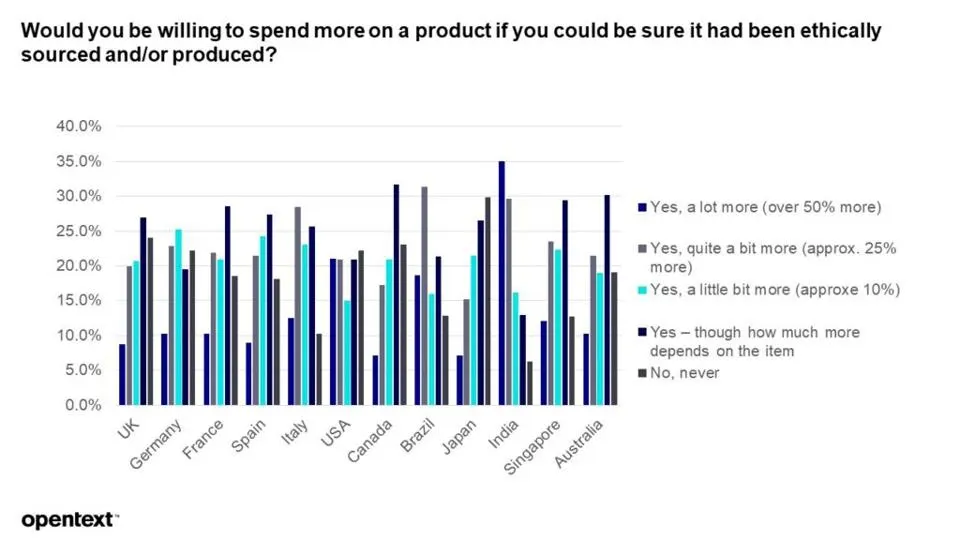
Additional evidence from the survey suggests that consumers have cared more about ethically sourced products as they have gained more awareness about the issue. When asked if they cared about purchasing products that are ethically sourced, 81% of respondents said yes. About 20% of these respondents said it had only mattered to them over the past year. As the survey was taken in 2021, this was likely referring to the pandemic. This is significant because of the supply chain delays and product shortages during the pandemic. These shortages directly affected consumers and are largely a product of a vulnerable supply chain plagued with labor abuses. As consumers gain more knowledge and awareness about the unethical exploitation and abuse of labor, they are more inclined to care about the issue.
The public’s passion for this issue has translated to real calls for the government to step in to take action. The OpenText survey reports that about 70% of respondents want the government to take action and introduce regulations that hold businesses accountable for responsible sourcing and production.
Tried Policy
Several policies have been enacted by the US to combat labor abuses abroad. Some policies go back decades, such as the Tariff Act of 1930. Section 307 of this act prohibits the importation of goods produced through forced labor, including child labor. This gives US Customs and Border Protection the right to detain shipments of goods suspected of being produced with forced labor. It does this by giving the US the right to levy customs duties on shipments, which will allow for the formal documentation needed for the US to check whether or not forced labor was used to manufacture a product. However, there is a de minimis tariff exemption outlined in the act, which according to Forbes exempts importers from paying customs duties on packages valued less than $800. Because companies like Shein and Temu use direct-to-consumer shipments, instead of bulk shipments, their imports are usually worth less than $800, and companies have used this exemption to their advantage. This exemption prevents companies from being checked for abusing labor laws because there is no formal documentation for the packages, and there. These exemptions have been used to circumvent labor regulation in the US in other instances as well.
In addition, policies have been enacted to ban products from certain areas where labor abuses are prevalent. In December 2021, President Biden signed the Uyghur Forced Labor Prevention Act(UFLPA), which banned products manufactured in Xinjiang. The Chicago Council on Global Affairs reports that this was enacted following the discovery of forced labor of minorities in China, namely China’s Muslim population, Uyghurs. The law asserts that any product from Xinjiang should be assumed to have used forced labor. However, companies are still able to use the de minimis provision to avoid labor regulations by using low valued imports. Anasuya Syam, the human rights and trade policy director at the Human Trafficking Legal Center, testified in a joint House and Senate hearing that no duty fees means no formal documentation, which they state is “a major impediment to collection of data necessary to enforce import bans.”
Another policy that was enforced internationally is the Bangladesh Accord. Adopted following the Rana Plaza tragedy, the Public International Law & Policy Group reports that the agreement made it mandatory for retailers and companies in Bangladesh to ensure safe conditions for their workers. To enforce this, it includes provisions that require companies and retailers to open factories to inspections, publicize the results of the inspections, and pay for any necessary safety repairs or adjustments. The Accord also allows workers to anonymously report any complaints or grievances they have about potential violations in factories. To make sure these complaints are taken seriously, an enforcement mechanism will work to take legal action against signatories. The Accord was oversaw by a steering committee, composed of trade unions, signatories, and the International Labor Organization as a neutral body. The Bangladesh Accord has been highly effective, reporting that it has conducted 38800 inspections, processed 1475 complaints, and had 577 factories remediated. The Accord was always meant to be a temporary system, to be succeeded by an International Accord run by the RMG Sustainability Council. As such, in September of 2021, the International Accord for Health and Safety in the Textile and Garment Industry went into effect. The Workers Rights Consortium reports that the International Accord contains most of the same provisions as the Bangladesh Accord, but it is meant to be at a larger scale. For example, the Department of Labor has reported that Pakistan became the second country with a legally binding agreement between global apparel companies and unions in December of 2022, as a part of the Pakistan Textile and Apparel Health and Safety Accord. Pakistan is also a part of the International Accord.
Policies have been acted both in the U.S. and abroad to combat labor abuses, and the scale they have been acting on has gotten bigger. For example, The U.S. passed the Uyghur Forced Labor Protection Act to punish labor abuses, despite the existence of the Tariff Act of 1930 banning products made with forced labor. Another example is the creation of the International Accord to expand the work done in the Bangladesh Accord. As these policies grow in scope, retailers and companies will be held to a higher standard of their practices, and they will be held accountable for their actions.
Policy Problem
A. Stakeholders
The Department of State is a major stakeholder in fast fashion labor abuses abroad because of the nature of the issue. Because many companies handle production abroad, the State Department’s unique position of enforcing foreign policy is crucial. In fact, the State Department has listed its own responsibilities and jurisdiction over labor abuses abroad. Some of the most significant responsibilities that can effect change with regards to labor abuses in foreign countries are cooperation with multilateral organizations and trade. Cooperation with multilateral organizations like the International Labor Organization give the U.S. government the opportunity to coordinate and communicate with other countries. This is crucial for the U.S. to be able to do things like monitor or collect data about labor regulations and abuses in different parts of the world.
Trade is another way the State Department can combat labor abuse abroad. Free trade agreements can be used to negotiate labor provisions. For example, a country might have to meet a certain benchmark of compliance with labor regulations to gain access to an incentive. In addition, the U.S. can work with embassies around the world to acquire information and hold countries accountable for labor abuse.
Additionally, the Department of Labor has the power and jurisdiction to help regulate and prevent labor abuses in foreign countries. For example, the Bureau of International Labor Affairs can conduct research and support diplomatic efforts to promote compliance with regulations. Additionally, the Department of Labor can enforce labor provisions in trade agreements like the United States-Mexico-Canada Agreement. The UMSCA includes provisions like the Rapid Response Labor Mechanism which allows the United States to take action against factories that do not comply with domestic regulations.
Congress is another major stakeholder in this issue. As a significant body with the authority to introduce legislation, congress has the power to introduce strict legislation regarding labor imports. Considering how much of fast fashion production occurs abroad and the extent of the labor abuse, congress has the responsibility of regulating imports. Specifically, the House Ways and Means Committee which has authority over tariffs, a powerful tool to regulate labor abuses abroad.
Several other stakeholders include consumers. If fast fashion companies see that consumers are taking notice of the labor abuses perpetrated by the company, they are more likely to take labor regulation into more serious consideration. The bottom line of these businesses is to make profit, which is coming from consumers. Consumers have the power to demand transparency in the supply chain and a stop to labor abuses. By choosing where to spend their money, consumers are voting with their wallet to show fast fashion companies what they care about. With enough people and attention to these causes, companies will be forced to change over time.
B. Risks of Indifference
If fast fashion labor abuses continue, the industry will continue to normalize ignoring labor regulations and rely on labor abuses. It sets a bad precedent for breaking labor regulations and international law. This precedent will give other industries and companies the signal that they can engage in labor abuses and get away with it, an especially dangerous notion considering how many industries abuse labor laws. The Department of Labor released a list of hundreds of goods which they believe to be produced with child labor or forced labor. These goods are from several industries, including agriculture, construction, food, and more. Indifference would mean allowing the labor abuses in these other industries to continue. Companies are more likely to follow labor regulations and laws if they see that they are being enforced.
In addition, the nature of fast fashion is that companies release apparel quickly to match trends. To keep that speed up and remain competitive, retailers have resorted to abusing labor regulations. At this point, that looks like low wages, child labor, unsafe working conditions, and long hours. If labor laws are not enforced, companies are then enabled to become even more extreme in their abuses of labor. Because of the competition, this will force other retailers to follow suit.
It will do a lot of harm to the economy to allow labor abuses to go unchecked and to spiral out of control. This is true for local economies and the global economy alike. Labor abuse will continue to make the global supply chain more vulnerable. Several sources advocate for this idea as well, such as the Center for Strategic & International Studies, which promotes the idea that as more workers are put at risk, more parts of the production are put at risk as well. A previously stated figure from the International Labor Organization estimates that about 4 percent of global GDP is lost each year due to poor working conditions. Examples like meat packing during the COVID-19 pandemic show how the supply chain is put at risk when workers are put at risk. Many workers were infected with COVID-19, and it is reported that meat production was reduced by 40% as a result. A supply chain vulnerable to disruptions has disastrous implications for all countries and economies. The RAND Corporation links it to international conflict, shortages, and inflation. Disruptions in the supply chain become more dire when it comes to industries like pharmaceuticals or agriculture. In addition, there have been several conflicts in history based on a lack of resources, and such conflicts would become much more likely as the supply chain becomes even riskier.
Lastly, the public has already made its voice heard by engaging in boycotts and social media campaigns. It is clear that the general public wants the government to act. A previously mentioned survey by One Poll stated that 70% of Americans want the government to take action regarding labor abuses. The longer the government remains indifferent to this issue, the public will become more frustrated with inaction and more likely to turn to things like boycotts. While boycotting brands that engage in labor abuse draws attention to the issue, it is ultimately harmful to workers themselves. The Business and Human Rights Resource Center reports that boycotting brands is not a solution that helps workers. In fact, boycotts lead to pay cuts and job losses. By allowing labor abuses to continue, the government would be forcing the public’s hand and allowing boycotts.
C. Nonpartisan Reasoning
The issue of fast fashion labor abuses is an entirely nonpartisan one because of the concerns it raises about topics that are high priorities for several different political ideologies. Firstly, the moral pitfalls of these labor abuses are not associated with any particular political ideology. It is morally wrong to violate the rights of millions of workers.
Democrats, for example, have traditionally concerned themselves with corporate regulation. The PRO Act passed in 2021, for example, works to strengthen workers’ rights to unionize and aims to hold corporations accountable for unfair labor practices. Additionally, the Corporate Transparency Act, requires companies to disclose their beneficial owners to prevent things like money laundering. These pieces of legislation point to a Democratic priority of corporate accountability, especially with regards to labor rights. This stands to reason that it is within Democratic concerns and priorities to regulate fast fashion labor abuses.
Additionally, Republicans have often shown concern with globalization, stating the loss of American jobs as a reason. Fast fashion labor abuses in countries abroad are made possible by a globalized economy and supply chain. Seeing that conservatives are worried about the negative effects on an increasingly other nonpartisan issue connected to labor abuses in fast fashion is the economy. As previously mentioned, the International Labor Organization estimates that about 4% of global GDP is lost due to labor abuses and poor working conditions.
There are aspects of fast fashion labor abuse that align with certain concerns that both major political parties in the U.S. have. In fact, bipartisan support has already been an important part of policies and legislation seeking to counter labor abuses abroad. For example, when the House of Representatives voted on the Uyghur Forced Labor Protection Act, only 2 representatives voted no. In the Senate, the bill passed unanimously. This type of cooperation in Congress is especially remarkable considering the highly polarized climate in the U.S.
Besides just the cooperation and interests of the two major political parties, the ethical implications of fast fashion labor abuse are within the concerns of most ideologies. These abuses threaten workers' lives, pay low wages, and exploit them. That is a concern that has nothing to do with political ideologies, but it is based purely off of the interests of human welfare.
Policy Options
- Pass the Fashion act.
The Fashion Act was introduced to the New York State Legislature in 2022. The bill would require companies generating more than $100 million in annual revenue to disclose information about their supply chain and production practices. The goal of this bill is to increase transparency between retailers and consumers and to hold companies accountable for their practices. It does this a few different ways. Firstly, the National Law Review reports that the bill would require companies to disclose 50% of their supply chain, meaning information like the names of suppliers. This would include everything from raw materials to final production. It also specifies that the company should disclose names of high risk suppliers. That means suppliers in areas where forced labor is prevalent or exhibit some quality of being at high risk for unfair labor practices. Additionally, the bill would require companies to disclose their due diligence policies, that is, practices meant for a company to understand their social and environmental impact. Lastly, the bill would necessitate that companies disclose the median wage of workers for high risk suppliers and how that wage compares to the local minimum wage. The Fashion Act forces companies to be transparent with customers about their practices throughout the supply chain, with an emphasis on giving the public the ability to monitor fashion companies for themselves. Though the Fashion Act was only introduced in New York, other states have expressed interest in a similar bill. Passing this bill on the federal level would empower consumers to make a conscious choice as to what companies and brands they want to support, based on a company’s practices. This is especially important, considering the fast fashion boycotts many people have been participating in. Additionally, in terms of feasibility, this bill would require minimal funding and resources. If fast fashion companies start to see that a majority of the public cares about these issues and will shop accordingly, it will force change in the industry.
- Adjust the de minimis exemption.
As previously mentioned, the de minimis exemption has made it harder for the U.S. government to regulate imports of products that used forced labor, child labor, or abused labor laws. It allows for imports valued less than $800 to enter the country without duties. This is harmful because it allows these imports to come under less scrutiny and means that there is no formal documentation for the imports. This lack of documentation makes it difficult to check the supply chain process to confirm that no labor laws were abused. This has affected the Tariff Act of 1930 and the Uyghur Forced Labor Protection Act, rendering both pieces of legislation largely useless against fast fashion companies. To revitalize efforts like these, the de minimis tax exemption needs to be reconsidered for fast fashion companies. In fact in 2022 alone, 30% of de minimis exempt packages came from Shein and Temu and the two companies ship nearly 600,000 packages daily to the US. This speaks to the extent that companies are able to avoid labor regulation because of the de minimis exemption. However, this is not to say that the tax exemption should be eliminated altogether. The National Foreign Trade Council, for example, reports that the exemption lowers costs, speeds up the supply chain, and allows for low-income communities to access products they may need. Eliminating the tax exemption would have harmful effects on the economy, but adjusting the requirements for a company to qualify for them can be effective to prevent labor abuses. For example, the government can disqualify a company for the exemption if they are suspected to be engaging in labor abuses. The government already has the resources and framework in place to support such a change. The State Department, for example, has a trafficking in persons report that details the efforts taken worldwide to combat human trafficking, including labor trafficking. Additionally, the Department of Labor publishes a list of products and goods produced by forced labor or child labor. This information can be used to assess and disqualify companies from the de minimis tax exemption, enabling the U.S. government to more thoroughly check imports for labor abuse.
- Sign the International Accord.
The International Accord is an incredibly important part of the fight against labor abuses because of its consistency. Whereas individual countries might be stalled in enforcing labor standards, the International Accord provides a comprehensive program to monitor labor abuses. Some of its most important programs include running inspections of factories for safety hazards, giving workers the ability to anonymously complain about safety concerns, and incentivizing brands to comply with labor standards. Things like inspections are something the U.S. cannot conduct abroad, due to national sovereignty. An established organization like the International Accord with experience from other countries has the power to effectively monitor progress in the actual communities where labor abuses are occurring. There has already been significant success with countries like Bangladesh and Pakistan. The Pakistan Accord, for example, has had 120 signatory brands and covered inspections for 500 factories, despite only being established in December of 2022. The Bangladesh Accord, as previously mentioned, has been highly effective, reporting that it has conducted 38800 inspections, processed 1475 complaints, and had 577 factories remediated. However, a major obstacle that stands in the way of the success of the International Accord is the number of mainstream brands that have agreed to be signatories. Some retailers like Levi’s, Gap, Walmart, and Amazon have not become part of the Accord. In addition, several countries have not become part of the Accord. To combat these two issues, the U.S. should incentivize different retailers and countries to become a part of it. With regards to retailers, the U.S. has a record of providing incentives like tax credits to retailers for actions like switching to wind or solar energy. Some of these incentives include tax credits. If the U.S. implemented such a program for the signing of the International Accord, more retailers would be financially incentivized to become a part of it. In terms of encouraging countries to become part of the Accord, the U.S. can leverage its diplomatic relations to have countries join. Oftentimes, foreign aid is allocated only when certain benchmarks are met. A similar model can be used for this, asking countries to join as a benchmark that shows their commitment to protecting labor rights.
- Strong labor provisions in trade deals.
For the most part, the U.S. government has little power abroad to run inspections to monitor labor practices because the U.S. has to respect the sovereignty of other countries. The best way for the U.S. to monitor labor practices is through trade agreements. Brookings reports that including labor provisions as standards and benchmarks to meet will encourage countries to maintain worker protections. This is only possible with the incentives and trade-offs worked into a trade agreement. A significant example of how strict labor standards can be worked into trade agreements is the United States-Mexico-Canada Agreement. The Department of Labor reports that the USMCA has the most far-reaching labor standards of any trade agreement because they are fully enforceable. The enforcement mechanism of the agreement allows the U.S. to take action against individual factories if they fail to comply with domestic law. Lastly, it allocates specific funds to monitor labor practices. $30 million, for example, will be allocated over eight years for the Bureau of International Labor Affairs to monitor compliance with regards to the trade agreement. If the government prioritizes these labor abuses abroad in the crafting of trade agreements, it could have much more power to monitor labor abuses around the world. This is especially important for trade with countries that have an extensive record of labor abuse.
Besides just monitoring labor practices, trade agreements can be used to encourage stronger labor regulations. The U.S. can use foreign aid or the inclusion of a country in a trade agreement to incentivize foreign countries to improve their labor standards. This would be especially significant because so many companies move abroad for production because of lenient labor regulations. Partnering with other countries is the best way the U.S. can enforce labor standards abroad.
Conclusions and Recommendations
Fast fashion labor abuses serve as an affront to human welfare, putting workers through horrendous conditions and risking their lives in the process. If left unaddressed, these labor abuses will continue to harm the economy, hurt workers, and set a dangerous precedent for enforcing labor regulations. The scale of this issue demands a comprehensive approach that includes companies, governments, and the workers themselves. There are several policies that would work towards this end. The policies suggested in this brief will combat labor abuses in three major ways.
Firstly, transparency is key to accountability. The Fashion Act would allow for transparency in the supply chain, and it would give consumers the power to decide which brands they want to support. It is already clear that the majority of the public has expressed serious concerns with the labor abuses prominent in the fast fashion industry and others. As companies take notice that consumers care about the labor abuses in the supply chain, they will be forced to change their practices.
Secondly, strong government monitoring of labor abuses is important. Adjusting the de minimis exemption would allow for better documentation and understanding of the supply chain. It would also keep companies accountable, as the U.S. could report any violations of human rights and labor regulations based on what they saw in the supply chain.
Lastly, it is imperative that programs are developed locally to support workers in different countries. This is where policies like the International Accord come into play. Reporting violations is definitely important, but local programs have the unique opportunity to conduct inspections and such on the ground.
With these 3 approaches to combating labor abuses, companies will be held accountable, workers’ safety will be protected, and the economy will be preserved.