.jpg)
.jpg)
.jpg)
.jpg)


.svg)


.svg)
1. Executive Summary
Unincorporated Alameda County faces a growing housing crisis shaped by weak tenant protections, limited enforcement systems, and the absence of municipal governments. Although the county adopted a Just Cause for Eviction ordinance in February 2025, there is no enforcement infrastructure to uphold it. Renters in unincorporated areas have no rent board, hearing processes, or oversight body to review violations, which leaves many residents without practical protection. Measure W was meant to support housing stability, yet its programs have not reached the communities that most heavily rely on county governance. This memo recommends two coordinated strategies to fill these structural gaps: establishing an Independent Rent Board with elected commissioners and launching a Measure W-funded Community Land Trust partnership for long-term affordability.
The first recommendation is the creation of an Independent Rent Board modeled after the Berkeley Stabilization Board. This institution would finally give unincorporated residents a formal venue to enforce the Just Cause ordinance, monitor rent increases, and resolve disputes. Elected commissioners from each major unincorporated community would oversee a rent registry and implement clear enforcement procedures with multilingual staff support. Over time, the Board would expand outreach, coordinate with county agencies, and adjust practices based on data and community feedback.
The second recommendation is a Measure W-funded Community Land Trust program designed to acquire, preserve, and rehabilitate housing in unincorporated areas. A working group led by the Alameda County Housing & Community Development Department (HCD), the Treasurer-Tax Collector, community organizations, and existing Community Land Trusts (CLTs) would identify properties and facilitate acquisitions to secure permanently affordable housing. Drawing from the successful Los Angeles County model, this approach reduces costs, expands deeply affordable housing, and prevents displacement before it spirals into homelessness. Measure W’s remaining one-time funds and ongoing Home Together allocations make a pilot feasible and scalable.
Together, these recommendations deliver what unincorporated Alameda County currently lacks: an institution to enforce tenant protections and a housing strategy that secures long-term stability. The rent board ensures Just Cause protections are not symbolic but enforceable, while the CLT program builds a pipeline of permanently affordable homes. Alameda County has the resources and responsibility to act. By adopting these models, the county can shift from reactive crisis management to proactive prevention and finally provide unincorporated communities with the support and protection they have long been denied.
2. Background Research
2.1 Past Marginalization of Unincorporated Communities
An astounding 37% of the U.S. population reside in unincorporated communities and face a significant representation deficit (Welch, 2024). Located outside of the legal boundaries of incorporated cities, unincorporated communities are small, low-income areas that lack municipal governments, city departments and services such as fire, police, and public works. This forces them to rely on their county government for funding, accommodation, and representation purposes. While county supervisors are required to represent all county residents, it can be difficult to garner attention and convince said representatives to focus on local matters because they are also responsible for broader, county-wide issues, placing unincorporated areas at a major disadvantage (Krans, 2025). Advisory councils exist but hold little authority (Change How Unincorporated Communities Are Governed, n.d.), replacing constituent advocacy with mere passing along of information.
As a result, unincorporated areas are more vulnerable to pollution, flooding, and climate change, and limited emergency resources raise risks during disasters (Appendix A) (Community Climate Action Plan and Safety Element Update - Planning - Community Development Agency - Alameda County, n.d.). In Alameda County specifically, unincorporated areas also receive the short end of the stick funding-wise, receiving only around 8% of Alameda County’s FY 2025-26 final budget, $380 million even though it is home to over 150,000 residents — nearly 10% of the county’s population. These modern inequities echo Russell City’s history of extraction and erasure (Appendix F). Russell City was founded in 1853 as one of the few unincorporated areas where Black and Latino families could own property because cities like Hayward barred them through discriminatory zoning and lending. The community lacked basic infrastructure such as sewage and electricity, and repeated petitions for services were ignored. In the 1960s, Alameda County and the City of Hayward used eminent domain to seize Russell City properties for redevelopment, displacing more than 1,400 residents. While Russell City can no longer be found on a map, the history and downfall of this East Bay unincorporated area hold important lessons (Krans, 2025). As such, addressing the needs of unincorporated areas and directing funding here enables the county to fulfill its unique responsibility, address inequities, and ensure that residents receive the basic services and dignity they have long been denied.
2.2 Housing Struggles in Unincorporated Regions
The concerns in unincorporated areas are reflected by a survey done in the Eden Area. The Eden Area is 25.2 sq miles of land located in central Alameda County, consisting of five unincorporated communities: Ashland, Cherryland, San Lorenzo, Fairview, and Castro Valley. The 2023 survey of residents aimed to identify what these individuals’ most pressing needs were and ultimately, four findings were highlighted. First, renters faced severe habitability issues, with one-third of renters living in housing that no longer met the state’s minimum standard of habitability. Second, rent increases were leaving many residents with a worsening fear of eviction. Third, many tenants had chosen to self-evict in response to verbal harassment from a landlord. Lastly, one-third of families in single-family homes were not protected by state tenant protection regulations. Overall, the survey provides significant insight into the unjust living conditions and struggles that individuals in unincorporated communities face. Among the many housing issues, this memo will focus on the second and fourth issues, of protecting tenants.
Alameda County has some of the highest eviction rates among the nine Bay Area counties. Between July 2023 and June 2024, there were 6,340 eviction filings countywide (“Evictions in the Nine-County Bay Area,” 2025). Unincorporated communities such as Fairview and Sunol were especially impacted, with about 8% of the renter population filing eviction lawsuits in ZIP code 94542 (which includes some areas of Fairview), and about 3% in ZIP code 94588 – which includes Sunol (BAHFA Bay Area Eviction Study – Regional Eviction Dashboard, 2025). High eviction rates are a strong predictor of housing instability and potential homelessness. Without targeted interventions, households in these areas face disproportionate risks of displacement, which threatens to worsen the county’s broader homelessness crisis.
In Alameda County, the Eden study highlights a clear connection between eviction density and areas with limited municipal infrastructure or county-administered housing programs. Unincorporated areas report higher eviction rates, suggesting that the aforementioned geographic and administrative boundaries play a role in housing instability. Another report from UC Berkeley’s Urban Displacement Project and the California Housing Partnership found that “increases in housing prices in Alameda County were correlated with shifts in where low-income people of color lived between 2000 and 2015,” as well as the fact that these shifts led to new concentrations of poverty and racial segregation. These show the strong correlation between housing struggles and unincorporated regions, especially for marginalized populations.
3. Existing Solutions
3.1 Measure W
A potential recent solution is Measure W funding, addressing housing issues, which is designated to have some focus areas on unincorporated regions. Measure W, a half-cent sales tax passed by Alameda County voters in 2020, raised approximately $810 million from January 2021 through June 2025, with projected annual revenue of $170 million through 2031 (Measure W, 2025). The measure funds two key programs: the Home Together Fund (HTF), which is aligned with the county’s homelessness response strategy and administered by the Health Care Services Agency, and the Essential County Services Fund (ECSF), administered across various departments to maintain social safety-net programs.
Spending is divided across four categories:
- Accrued funds: $395 million allocated to the HTF in December 2024, and $6.5 million to the ECSF in June 2025 ($4.5 million for food procurement and delivery, $2 million for senior services).
- Prudent reserve: $170 million set aside for future fiscal uncertainty.
- Remaining one-time funds: $238.5 million, to be split 80% to the HTF and 20% to the ECSF.
- Future sales tax revenue: Estimated $1.02 billion through 2031, distributed at the same 80/20 ratio (Board of Supervisors Meeting, 2025).
However, the current Measure W allocations fail to meet some needs of unincorporated regions. The county-wide services for the HTF are summarized based on the funded programs illustrated below. The ECSF covers a range of countywide services, such as food security, infrastructure, and housing. In June 2025, about $6.5 million was allocated to the ECSF from one-time accrued Measure W funds: $4.5 million for food-related services and $2 million for senior services via the Social Services Agency’s Area Agency on Aging. Current measures cover specific target populations such as those in encampments and convicts. Other initiatives provide targeted responses such as healthcare, emergency response and shelters (Appendix B). The relevant initiatives are explained below, focusing on the gap in addressing Just Cause Eviction and the provision of affordable long-term housing.

3.1.1 Housing Navigation
Alameda County’s housing navigation services are designed to connect unhoused or housing-insecure individuals with available units and financial aid, but current systems largely focus on short-term crisis resolution rather than sustained stability. Many residents report that once initial assistance concludes, re-engagement with navigators or county services is difficult, creating gaps in follow-up and continuity of care (Planning, n.d.). This issue is especially acute in unincorporated areas, where navigation centers and outreach infrastructure are limited. Long-term case management, landlord mediation, and rent-stabilization linkages are missing, which weakens the overall housing retention framework.
3.1.2 Increase Housing: CDA: AC Housing Plan
The Alameda County Housing Plan (2025–2035) is the County’s 10-year strategy to address the housing crisis by expanding affordable housing, ending homelessness, and strengthening housing stability across all communities. Developed by the Housing and Community Development Department (HCD), the plan lays out a framework to produce 20,000 new affordable units by 2035, including 7,385 units of permanent supportive housing and over 10,000 units for acutely low-income households earning below 20% of the Area Median Income. The Plan focuses on seven core priorities: addressing and preventing homelessness, building and preserving affordable housing, stabilizing families in crisis, promoting racial equity, and creating sustainable funding streams for long-term housing solutions. The County projects a need for 107,000 new affordable housing units and 2,200 new shelter beds to achieve a healthy housing ecosystem.
HCD’s approach integrates production, preservation, and protection strategies, acknowledging that while the market produces higher-cost housing, the government must take the lead in funding deeply affordable and supportive housing. The Plan builds on the success of Measure A1, which exceeded its goal by creating over 4,500 affordable homes, and sets a roadmap for future countywide collaboration among public agencies, nonprofit developers, and private partners. The Housing Plan explicitly includes Alameda County’s unincorporated communities, such as Ashland, Cherryland, San Lorenzo, Castro Valley, and Fairview, within its housing goals and funding strategies. Because these areas do not have their own municipal housing departments, HCD serves as the primary housing authority and development agency for unincorporated regions. This means HCD directly administers affordable housing investments, rental assistance programs, and anti-displacement efforts in these communities, ensuring they receive the same level of support as incorporated cities.
3.1.3 BHSA housing interventions
The Behavioral Health Services Act (BHSA), passed by voters in March 2024 as Proposition 1, is Alameda County’s key framework for expanding housing and treatment options for individuals experiencing serious mental illness or substance use disorders. The initiative merges the state’s Behavioral Health Infrastructure Bond (AB 531) and the Behavioral Health Services Act (SB 326), shifting the system’s focus toward people with the most acute behavioral health needs–particularly those at risk of homelessness. BHSA dedicates 30% of its funding to housing interventions, which include rental subsidies, shared housing, family housing for youth and children, and transitional rent assistance. Half of that amount (50%) is reserved for chronically homeless individuals, while up to 25% can support capital development—such as building or rehabilitating supportive housing sites. These housing investments are paired with treatment, recovery, and case management services through Full-Service Partnerships, ensuring that people can stabilize long-term rather than cycle through homelessness and crisis systems.
BHSA housing interventions are countywide, serving residents in both incorporated cities and unincorporated communities like Ashland, Cherryland, Castro Valley, San Lorenzo, and Fairview. Alameda County Behavioral Health manages these funds directly so unincorporated areas are fully covered. Residents in these areas can access BHSA housing resources through the Behavioral Health Access line (1-800-491-9099) or via county referral networks such as 2-1-1 Alameda County. By centralizing housing coordination under Alameda County Behavioral Health, the program helps bridge service gaps that typically leave unincorporated communities underserved.
3.2 Other Housing Measures
3.2.1 Alameda County Housing Secure
Centro Legal de la Raza and ACHS’s legal partners provide services to all individuals, regardless of immigration status. There is no policy on excluding residents of unpermitted/substandard housing. ACHS exists to cater to low-income residents, although there is no quantitative threshold specifically listed. Currently, there is no publicly available data on the percentage of eligible unincorporated residents served by ACHS eviction defense programs, denial rates and reasons for denial, or waiting lists.
3.2.2 Statewide Tenant Protection
One of the most important statewide tenant protection programs is the California Tenant Protection Act of 2019 (AB 1482). This law requires just cause to evict any tenants that have been residing in a property for over 12 months, both for month-to-month rentals as well as fixed leases. It also limits rent increases; rent may only be raised twice in a 12-month period, and any increases may not exceed a 5% rent cap + CPI, or 10%, whichever is lower. The law covers all properties with 1) at least two units and 2) that are older than 15 years. Because it is state law, unincorporated communities are covered by it.
3.3 Gaps in Existing Measures
Given the programs available under Measure W and supporting initiatives, we identified two major gaps. First, a successful Measure W should establish robust tenant protections by holding landlords accountable. This includes strict enforcement of rent registries, mobile home protections, and eviction defense programs. These measures would allow the County to monitor compliance with rent caps and eviction policies while protecting tenants from harassment and abuse. Furthermore, it is increasingly apparent that fair and equitable allocation of resources is of the utmost importance for an effective Measure W. An effective Measure W should also prioritize investment in long-term housing stability for disenfranchised residents. This solution would address the long-standing issues of homelessness, lack of affordable housing, rent hikes, and severe inhabitability of current housing by offering affordable housing options, rental assistance, long-term housing subsidies, and assistance with moving costs. To understand these gaps better, we uncovered more details about each problem and proposed a relevant solution, focusing on the issues separately.
4. Tenant Protection through Rent Boards
4.1 Comparative Analysis of Tenant Protection
The lack of tenant protections is a significant gap because tenants remain housed only when those protections are in place. This is crucial because the prevention of homelessness is important in ensuring that it does not continue. Moreover, the process of finding housing for an unhomed person is typically a lot more complicated than the process of ensuring that a tenant is well-protected. To understand this, we did a case study on Los Angeles and San Diego, selected for their stronger tenant protection laws.
4.1.1 Case Study 1: Los Angeles (LA) County Unincorporated Areas
LA’s Rent Stabilization and Tenant Protections Ordinance (RSTPO, effective April 1, 2020) is one major form of tenant protection. This permanent county ordinance caps annual rent increases for most multifamily units with certificates of occupancy dated on or before Feb 1, 1995 (with the exemption of single-family homes and newer units) in unincorporated LA County, limiting rent increases to around 8% per year (LAHSA Applauds Extension of Tenant Protections, n.d.). The RSTPO also established “just cause” eviction rules, meaning landlords cannot evict tenants in covered units without a valid at-fault reason (e.g. nonpayment, lease violation) or a specified no-fault cause. This protects roughly 400,000 residents in unincorporated areas within LA County from evictions without cause and excessive rent hikes (Inner City Struggle, n.d.).
LA also has the Mandatory Relocation Assistance (No-Fault Evictions 2020). Under the RSTPO, if a tenant in an unincorporated area is evicted for a no-fault reason, the landlord must pay relocation assistance to the displaced tenant (LAHSA Applauds Extension of Tenant Protections, n.d.). The amount is set by County rules, and additional assistance is required for certain vulnerable groups, including seniors above 62, disabled tenants, low-income households, or those with minor children to help them relocate. The RSTPO also contains an anti-harassment provision (sometimes called the “Retaliatory Eviction and Anti-Harassment Ordinance”) which forbids landlords in unincorporated areas from using tactics like shutting off utilities, threatening or intimidating tenants, or refusing repairs to pressure a tenant to move out (LAHSA Applauds Extension of Tenant Protections, n.d.). Tenants can use these provisions as a defense in court or sue landlords for violations, adding another layer of protection beyond rent and eviction rules.
4.1.2 Case Study 2: San Diego (SD) County Unincorporated Areas
SD’s tenant protection is enacted through the State Rent Cap & Just Cause Law (AB 1482 – effective Jan. 1, 2020). Although not a county ordinance, California’s Tenant Protection Act of 2019 applies in unincorporated San Diego County. It caps annual rent increases at 5% plus local inflation (CPI), up to 10% max, and requires “just cause” for evictions after a tenant has lived in the unit for 12 months (El Cajon Homelessness Forum, n.d.). It also mandates relocation assistance equal to one month’s rent for any no-fault eviction (landlord can waive the final month’s rent instead). The County of San Diego does not impose its own rent control in unincorporated communities. In a public Q&A, a county supervisor confirmed that the County has chosen not to enact rent control for local rentals (El Cajon Homelessness Forum, n.d.). Thus, apart from the state’s rent cap (AB 1482), unincorporated area landlords can raise rents without additional county-level limits.
SD also has the Rental Assistance and Eviction Prevention Programs. San Diego County has focused on programmatic tenant assistance in unincorporated areas. In 2022, the County launched a “Shallow Rental Subsidy” pilot to prevent senior renters from becoming homeless. This program (expanded in May 2024) provides selected at-risk seniors (55+ years old) in the unincorporated region with $500 per month towards rent for 18–24 months, paid directly to their landlords. By subsidizing rent for hundreds of low-income seniors, the County aims to stabilize tenancies and avoid evictions. The County also partners with legal aid and community organizations on eviction prevention services, offering education, counseling, and referral to resources for unincorporated-area tenants facing financial hardship or landlord disputes.
The differences in policies in the two regions are summarized below.

4.1.3 Comparison with Incorporated Areas of Alameda County
While unincorporated areas have limited tenant protection, many of these are enforced on a city-level. To understand the disadvantages faced by unincorporated Alameda, a comparison is made.

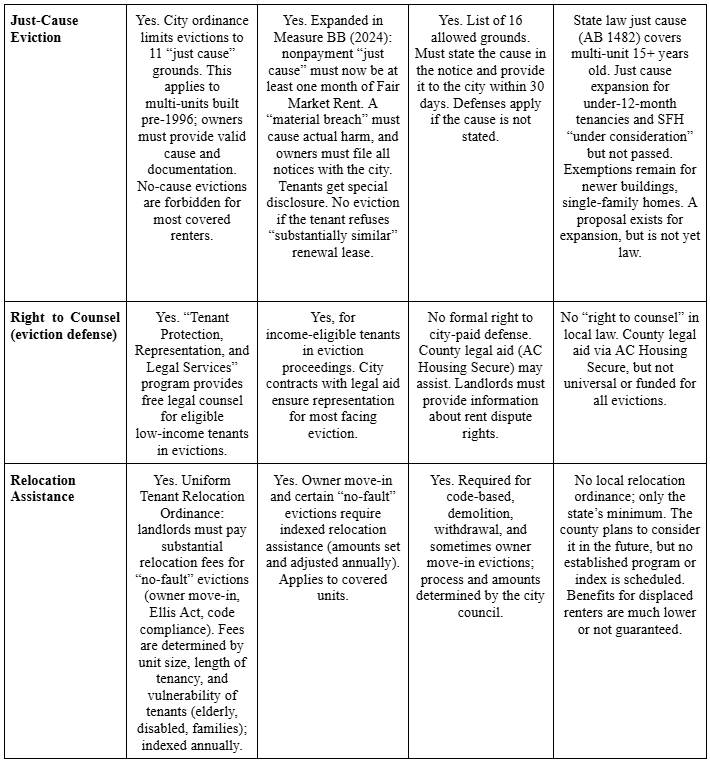
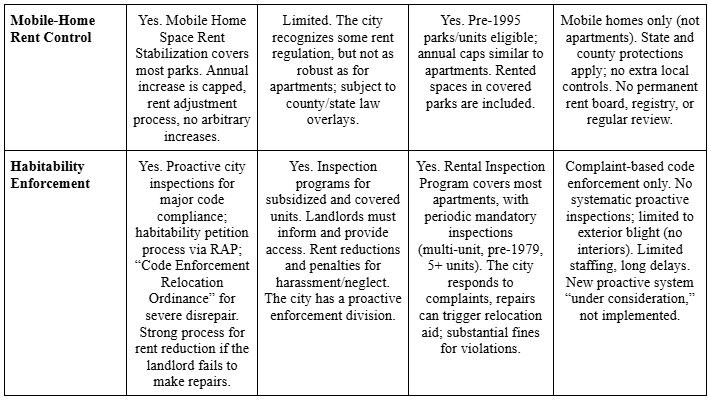
4.1.4 Gaps in Alameda’s Tenant Protection
Alameda County’s unincorporated areas lack four tenant protections that are present in other cities and counties in the United States: 1) comprehensive rent registry programs, 2) robust tenant anti-harassment ordinances, 3) enhanced just-cause eviction protections, and 4) proactive code enforcement programs.
1) Unlike cities such as Berkeley and Los Angeles, which maintain comprehensive databases tracking rental properties and rates, Alameda County only established a basic registry in 2022 that focuses on requirements rather than comprehensive rent tracking and stabilization. The county’s registry requires property owners to register units and pay annual fees, but does not provide the same level of rent control oversight.
2) While cities like Los Angeles have implemented strong Tenant Anti-Harassment Ordinances (TAHO) with specific prohibited behaviors, civil penalties up to $10,000 per violation, and criminal misdemeanor charges, Alameda County’s unincorporated areas lack these protections. The County initially considered including anti-harassment provisions in its rental registry, but later removed these requirements during the legislative process. This is a critical protection gap as tenant harassment is a significant issue in Ashland, Cherryland, and San Lorenzo, where residents face housing instability and fear of retaliation (Alameda County Community Development Agency, 2022).
3) Although Alameda County’s protections were passed in February 2025, they remain limited and poorly enforced. The ordinance provides only basic enhancements to state law, including 90-day notices for vulnerable tenants and two months’ relocation assistance. In contrast, incorporated cities like Oakland have comprehensive just cause ordinances with broader protections, more extensive relocation assistance, and stronger enforcement mechanisms. The county’s just cause ordinance also has significant exemptions and only applies to single-family homes when landlords own five or more units in unincorporated areas.
4) The county operates primarily on a complaint-based code enforcement system with limited dedicated funding or staff. While there is a pilot rental housing inspection program, it remains focused on responding to complaints rather than proactive inspections. This contrasts with cities like Los Angeles that conduct regular inspections. Cities maintain more comprehensive code enforcement with programs like the Rent Escrow Account Program (REAP) and Tenant Habitability Plans, which are not available in unincorporated areas. The county code enforcement division primarily focuses on exterior blight and zoning violations, rather than interior habitability conditions that affect tenant health & safety.
In unincorporated Alameda County, tenant protections exist only on paper, as they remain unevenly enforced. The county adopted a Just Cause for Eviction ordinance in February 2025, extending basic protections to renters in unincorporated areas for the first time (Just Cause for Eviction Ordinance, 2025). The policy prohibits evictions without a legally defined reason, such as nonpayment of rent, substantial lease violations, or wrongful move-in. However, the ordinance was enacted without the necessary enforcement structure. There is no rent board, oversight body, or clear reporting process for violations. This gap leaves many renters uncertain about how to assert their rights or challenge illegal rent increases and evictions.
In 2023, data shows that 72% of surveyed renters in unincorporated Alameda County reported rent increases within the past year, many exceeding state limits under California’s Tenant Protection Act. Some tenants reported facing informal evictions, harassment, and even unsafe living conditions after questioning rent hikes (My Eden Voice, 2023). The lack of enforcement mechanisms means these violations often go unaddressed. Establishing a rent board would provide a centralized body to oversee compliance, mediate conflicts, and collect data on local housing trends. Without such a structure, the Just Cause ordinance cannot effectively protect tenants or prevent cycles of instability that continue to shape the County’s unincorporated housing landscape. As a result, Alameda County should establish a Community Land Trust Acquisition Fund using funding from Measure W’s HTF Capital Acquisition.
4.2 Rent Boards as a Solution
A rent board offers a promising solution to the issue of tenant protection in Alameda. To understand the potential solution, we study Los Angeles County, as the only unincorporated California county with a dedicated rent board. Operating a nine-member Rental Housing Oversight Commission (RHOC), the LA rent board began hearing appeals in 2023 (Los Angeles County Consumer and Business Affairs, 2022). The RHOC consists of five members appointed individually by each Supervisor, plus four stakeholder representatives, all serving at the Board's discretion. The Commission functions as an appellate body reviewing determinations made by the Department of Consumer and Business Affairs (DCBA) on rent stabilization and tenant protection matters through bi-weekly hearings. DCBA enforces the Rent Stabilization and Tenant Protections Ordinance while RHOC hears appeals and renders binding decisions after reviewing evidence and testimony. The program is funded through annual registration fees of $90 per covered rental unit (Los Angeles County Consumer and Business Affairs, 2022). Other California counties with substantial unincorporated populations—including San Mateo (Home for All San Mateo County, 2023), Contra Costa, Riverside, San Bernardino, Orange, and Sacramento—have no rent boards for unincorporated areas and rely on state law AB 1482 for baseline tenant protections (Bill Text - AB-1482 Tenant Protection Act of 2019: Tenancy: Rent Caps., n.d.).
Despite passing substantive tenant protections (Alameda County Community Development Agency, 2022), Alameda County still lacks a dedicated rent board or enforcement mechanism. The County’s Just Cause for Eviction ordinance (Just Cause for Eviction Ordinance, 2025), effective March 6, 2025, requires relocation assistance up to $10,000 per household but provides no corresponding enforcement framework (Cowley, 2025). While Los Angeles County's DCBA processes complaints with staff funded by registration fees, Alameda County’s enforcement has no dedicated funding or personnel (Board of Supervisors Unincorporated Services Committee Staff Report, 2023). Alameda’s three-year policy plan considers creating a rent board "should funding be made available" and establishing a proactive rental inspection program by Year 3, but these remain unfunded proposals (Alameda County Board of Supervisors Approves Suite of Tenant Protections, 2025). This structural gap illustrates why administrative infrastructure is essential to ensure compliance with protection ordinances.
4.3 Rent Board Functions
Rent boards play five critical roles in supporting tenant protection, as illustrated below.
Firstly, rent boards process requests for rent increases or decreases by accepting formal petitions from landlords and tenants. These petitions outline reasoning and provide supporting evidence for each request (City of Berkeley, n.d.). After a petition is submitted, both parties are notified, and a hearing date is set where both sides can present their argument before a hearing officer. A written decision is issued after the officer looks through all documents, at which point there is a 35-day buffer for appeals. Petitions can address issues like repairs, loss of amenities, or an unlawful rent increase. The board may inspect the property, review previous contracts, and issue a decrease if warranted. Mediation and inspections often occur before the final hearing to resolve issues or verify claims (The Petitions and Hearings Process, n.d.). For example, between 2014 and 2019, Oakland averaged 847 petitions per year, highlighting the scale of tenant concerns around rising rents (“Follow up Report - Rent Adjustment Program,” n.d.). Additionally, in Mountain View, a team from the city analyzed data from the Housing Department Rent Stabilization Division. From November 2017 to June 30, 2025, a total of 291 petitions were filed, 93% of which came from tenants. These petitions were submitted under the Community Stabilization and Fair Rent Act (CSFRA) and the Mobile Home Rent Stabilization Ordinance (MHRSO). Residents may file a petition either to request a rent increase above the annual allowable limit or to seek a rent reduction due to unlawful rent increases, habitability or maintenance issues, or tenant hardship (City of Oakland, n.d.).
Secondly, rent boards also adapt to local needs with adapted policies. For example, Berkeley’s Rent Board played an integral role in developing Measure BB, a 2024 ballot measure. The purpose of this measure was to issue changes such as expansion of protections for government-subsidized units, modification of just-cause eviction rules, 5% caps of annual general rent adjustments, and the development of noncompliance fines (Measure BB Changes to Berkeley’s Rent Ordinance, n.d.). The Board also made these changes clear by publishing updated documents of comparison between the old policies and the refined policies.
Thirdly, in many incorporated areas, there are well-established examples of how local governments administer rent registries and use the collected data. These jurisdictions not only manage the technical process of registering rents but also conduct regular analyses to identify trends, monitor compliance, and inform housing policy decisions. For instance, Oakland operates a rent registry. To administer the system, owners of covered apartment complexes must provide the address of each unit and the names and email addresses of all tenants (City of Oakland, n.d.). They must also report the lease start date, the initial rent, and the most recent rent increase. Owners submit this information through the city’s database, which is how Oakland collects and maintains accurate data. Within the city, the requirement applies only to apartment buildings covered by Oakland's rent control and eviction policies, specifically those built before 1995. If an owner fails to comply, they are not allowed to petition for a rent increase. The rent registry also helps tenants verify whether their apartment is covered under rent control (City of Oakland, n.d.). For example, places like Los Angeles use their rent registry data to track allowable annual rent increases, identify illegal rent hikes, and ensure they maintain an affordable housing stock. They also use the registry to identify units that are not properly registered, so the county can intervene and ensure landlords are not charging more than what is allowed (Borges, 2025). On the other hand, the city of Alameda uses their rent registry to catch violations, return money to tenants, track market trends, and refine enforcement of rent control and eviction protections. For example, in March 2024, the Rent Program mailed 74 notices to landlords of potential violations, and 35 tenants were reimbursed $42,196 (Alameda County Rent Program, 2024).
Fourthly, rent boards also enforce housing regulations and resolve complaints by investigating tenant reports of violations, such as illegal rent hikes or health and safety problems. Investigators may inspect the property, review records, interview parties, and require landlords to fix any violations found. Orders to remedy violations may be issued, and penalties can be assessed for non-compliance. This process keeps housing safe and ensures laws are followed. Tenants can file complaints with boards or local housing departments, which trigger case review and possible inspection. Boards keep tenants updated and may require more documentation in ongoing investigations (Los Angeles Housing Department, n.d.).
Lastly, Berkeley’s Rent Board provides outreach and education programs for community understanding and engagement. Their Public Information Unit is responsible for organizing informational workshops and webinars, such as detailed sessions explaining Measure BB for both landlords and tenants, and participates in local community outreach events (Community Outreach, n.d.). Housing counselors offer topic-specific presentations and Q&A informational sessions to ensure that renters and landlords are aware of recent ordinance changes, know their rights, and are empowered to petition for redress or compliance (Outreach Committee, n.d.-b). This proactive outreach, delivered through in-person events, webinars, and collaborative partnerships, helps to build community awareness and reduce disputes.
4.4 Models of Rent Boards
4.4.1 Model 1
A prime example of an Independent Rent Board with Elected Commissioners is Berkeley’s Rent Stabilization Board, which consists of nine commissioners with four-year terms, selected by Berkeley voters. Upon re-election, commissioners are permitted to serve two terms, or eight years total, with exceptions made for those filling vacant Board seats (Rent Stabilization Board of Berkeley, n.d.). This allows for the remainder of the vacant seat to be served along with typical election and re-election, which warrants the typical two terms thereafter.
For petition adjudication, Berkeley’s Rent Board schedules a settlement conference and hearing, where a hearing examiner utilizes evidence and testimonies provided by both parties and witnesses to make a decision. That is final if neither party files an appeal within 35 days (The Petitions and Hearings Process, n.d.).
The Rent Board’s budget, $9,017,005 for 2025-26, works on a fiscal cycle from July 1st to June 30th the following year, with said budget and operations reviewed throughout the year by the Board’s Budget & Personnel Committee to ensure compliance with its policies. The Board maintains 29 full-time equivalent employees and charges annual registration fees of $344 per unit for fully-covered unit fees, $212 per unit for partially covered unit fees, and $96 per unit for Summer Fraternity and Sorority unit fees (Budget & Personnel Committee, n.d.).
An Independent Rent Board with Elected Commissioners, as illustrated by Berkeley’s Rent Board, offers many advantages for unincorporated areas, such as tenant stability with rent stabilization to prevent displacement, just cause eviction processes to protect tenants from arbitrary evictions, and rent control to prevent landlords from pricing out long-term residents. Conversely, this implementation could result in a reduced housing supply due to rent control, increased administrative and legal costs for the government and residents, landlord-tenant conflicts caused by increased regulation, and more legal disputes. Additionally, potential property maintenance concerns may arise to compensate for investment returns, as landlords seek to offset rent caps.
Ultimately, the Independent Rent Board with Elected Commissioners model is uniquely utilized by incorporated cities. Unfortunately, unincorporated areas are unable to reap the benefits of a dedicated dispute resolution and rent stabilization system provided by local representation, forcing them to rely on statewide laws that rarely cater to community needs.
4.4.2 Model 2
The governance model in Los Angeles includes an advisory body called the Rental Housing Oversight Commission (RHOC), whose primary mission is to safeguard tenants from unreasonable rent increases. The Rental Housing Commission is an appellate body with the power and authority to “enforce the procedures and guidelines prepared by the Department of Consumer and Business Affairs (DCBA) Director” (Rental Housing Oversight Commission, n.d.). They act as an additional oversight, resolving appeals made against the DCBA. RHOC may also overturn DCBA’s determinations. For example, the RHOC returned $16,142.15 to a tenant in 2023. But the commission does not have a final say regarding rent petitions. In Los Angeles, when city and county jurisdictions overlap, rent petitions are handled through the county’s “Just and Reasonable” program, which reviews and approves rent increase requests. And because the RHOC operates under a county structure, it does not serve as the final authority in Los Angeles County (Just & Reasonable Rent Adjustment Program, n.d.).
There is no specific evidence as to how the RHOC is funded. There is also no evidence as to how DCBA commissioners are paid, and they currently use volunteers appointed by the Board of Supervisors. The DCBA currently receives money from federal grants and county general funds, as it is a county agency.
LA County’s rental oversight model helps protect tenants from unreasonable rent increases by creating a transparent system with clear rules and a structured petition process. Being housed under the Department of Consumer and Business Affairs strengthens enforcement and supports rent stabilization, which reduces displacement. However, the system can be slow and bureaucratic since the Commission is not the final decision-maker, and many cases could also move through the city’s broader “Just and Reasonable” program rather than the county’s housing department (Just & Reasonable Rent Adjustment Program, n.d.). RHOC’s authority is limited, compliance can be burdensome for landlords, and overlapping city and county jurisdictions often cause confusion about where tenants should file petitions.
4.4.3 Model 3
The hybrid model should combine professional staff administration with binding authority on petitions while preserving city council control over general policy. Exemplified by Hayward's Residential Rent Stabilization and Tenant Protection Ordinance, this structure designates a Rent Review Officer to coordinate cases and assign them to trained mediators and arbitrators, who issue legally binding decisions on tenant petitions. The arbitrators would have "binding authority" over issues such as whether rent increases meet standards for cost justification. These decisions would be enforceable as administrative law (MuniCode Library, n.d.). The city council would still be in control of general policy development under a "presumptive adoption" model where staff recommendations are forwarded for elected official approvals (Wobbe & Wobbe, 2024).
The advantages of this hybrid model would include binding dispute resolution without full politicization, professional expertise, mandatory mediation that reduces contentious proceedings, and cost efficiency compared to utilizing independent agencies (Wobbe & Wobbe, 2024). However, some disadvantages would include a lack of proactive rent ceiling establishment (making it purely reactive to tenant petitions), potential delays and costs for tenants navigating the petition process, inconsistency in arbitrator decisions across cases, and inability to strengthen tenant organizing rights as in comprehensive systems like Berkeley.
4.4.4 Comparative Analysis of Rent Board Models
There are a variety of rent board models that each have their strengths and weaknesses. We will compare each model to find which one suits Alameda County based on different criteria and components. For Model 1, we examine boards with appointed commissioners by the people. Their system alludes to a court-like structure, with hearing parties and witnesses to argue their petition. This system not only utilizes commissioners, but has staff to accommodate them and charges any fees/decisions made by the petition. As for Model 2, the approach is strikingly similar. Instead of being appointed by the voters, the rent board would be appointed by the Board of Supervisors. Then the rent board would review petitions through agendas and debate without hearings or witnesses, like Model 1. An additional difference lies in their enforcement. For their enforcement, this is done within a county department called the Department of Consumer and Business Affairs. The Department of Consumer and Business Affairs administers the enforcement, while the rent board overrides DCBA's decision if it believes it was not made fairly. So, Model 1 is an extension of DCBA. Lastly, we have model 3. In Model 3, instead of a rent board, they have a rent review officer. They can make binding decisions, but ultimately, the city council has jurisdiction over whether or not to enact those decisions. But mainly, it is a review and adjustment of policy rather than enforcement.
By comparing and contrasting the different models, we can compare the speed of petitions. For Model 1, there are no concrete timelines to follow for petition filing and hearing, but once final decisions are made by the hearing examiner, one can take up to 35 days to appeal. There are no specific timeline guidelines regarding hearing and petition filing (The Petitions and Hearings Process, n.d.). In model 2, there is no specification on a timeline for review, as review takes place during agenda meetings. For Model 3, it can take a while for petitions to be reviewed and accepted, as it can take multiple days for each step of the process, ranging from 5 to 30, not consecutively but between each stage. This creates a lengthy wait process. As for the models, most require substantial time for both the tenant and landlord to respond.
Next, we can examine the metric of enforcement effectiveness given citation & compliance rates. Model 1 is the most effective for enforcement based on its accurate records through mandatory reporting requirements for eviction proceedings. Overall, there are high landlord compliance rates with registration fees covering all operating costs (Urban Habitat, 2018). Model 3 is effective in terms of professional staff administration with binding authority, which would decrease contentious proceedings. However, enforcement may lack consistency compared to permanent independent boards with established procedures.
Another aspect to highlight is political sustainability and community responsiveness. Once again, Model 1 would be most sustainable as elected commissioners provide direct democratic accountability and community representation (PolicyLink et al., n.d.). The structure of elected rent boards would protect against arbitrary political changes and maintain program consistency. When electoral accountability is present, community organization has proven to be strengthened. This is notable in New York City, where rent-stabilized tenants mobilized tens of thousands of voters to support candidates committed to rent control (PolicyLink et al., n.d.). In comparison, Model 3 and Model 2 do not provide direct electoral representation for the community, and therefore are at risk of being less representative.
Additionally, the financial capacity of each product, specifically its fiscal sustainability and startup costs, must be examined. Model 3 is the most fiscally sustainable as it demands lower startup costs by utilizing existing city staff and contracted mediators rather than creating a new independent agency like Model 1 or 2. Richmond’s FY 2025-26 budget of $3.9 million is funded entirely by rental housing fees ($267 per fully covered unit, $151 per partially covered unit), which establishes continued sustainability after its initial startup phase. Model 1 follows closely as all the operating costs in Berkeley were covered by landlord registration fees, but it is more costly than Model 3, given its higher administrative and legal costs with robust enforcement infrastructure, making the startup phase more expensive (Rent Board | Richmond, CA - Official Website, n.d.).
Lastly, given the coordination capacity with other tenant protection programs, Model 1 has the best capacity to be integrated. The independent rent board would act as a bridge between tenant associations and the county, which in turn would boost coordination efforts. Berkeley’s specialized committees could allow for adaptation to community issues without jurisdictional overlap. Model 3 follows closely behind as a separate rent review officer would help coordinate cases flexibly, but has the danger of inconsistent application across cases due to a lack of centralized oversight.
4.5 Final Recommendation for Rent Board
For unincorporated Alameda County, the ideal structure to model is Model 1 of the Independent Rent Board with Elected Commissioners, as exemplified by the Berkeley Rent Stabilization Board, because of its efficient processing speed, enforcement effectiveness, political responsiveness, fiscal sustainability, and coordination capacity. Through comparative research, Berkeley’s elected Rent Board is an ideal model for the proposed Alameda County Rent Board as it demonstrates efficient petition processing, attentive enforcement, political responsiveness, and fiscal sustainability. A My Eden Voice survey reported that 39% of Eden renters fear displacement within a year, 25% fear eviction, and 64% are unaware of their legal rights: issues easily mitigated by an elected board through accessible dispute resolution. Alameda County ranks among the top three Bay Area counties for eviction rates, with 85-97% stemming from nonpayment. A rent stabilization board would directly address this affordability crisis, which drives displacement. Currently, no unincorporated area has this model, forcing 60,000+ unincorporated renters to rely solely on statewide protections that do not directly address specific local needs.
This rent stabilization board, coordinated by Alameda County Housing & Community Development Department and Registrar of Voters, would serve all major unincorporated communities – Ashland, Castlewood, Castro Valley, Cherryland, Fairview, Hillcrest Knolls, Hayward Acres, San Lorenzo, and Sunol. This would cost around $8-10 million annually, modeled off of Berkeley’s 2025-26 fiscal budget of $9,017,005, and funded through per-unit registration fees ($344 fully-covered units, $212 partially-covered units) and Measure W supplementation which includes the Home Together Fund as well as the CLT funding solution provided above.
First and foremost, in phase 1, implementation should commence with new county legislation that establishes an Independent Rent Board consisting of at least one commissioner for each major unincorporated community in Alameda County, including Ashland, Castlewood, Castro Valley, Cherryland, Fairview, Hillcrest Knolls, Hayward, San Lorenzo, and Sunol. However, larger districts can justifiably seat two or three commissioners as a reflection of more responsibility for their communities with greater population sizes and petition volumes. These commissioners, around 9-12 total, would be elected directly by representatives in their respective areas and serve staggered four-year terms, as modeled in Berkeley, to ensure local accountability and true representation. Moreover, the Board should create and adopt bylaws, organize area-specific elections with the Alameda County Registrar of Voters, and launch a centralized rent registry and fee structure for units, mirroring Berkeley’s, with adjustments made for district size and local needs. To ensure success, initial hiring should place emphasis on multilingual staff and the development of accessible digital materials to increase accessibility for these communities from the beginning.
During phase 2, the second and third years of implementation, the Board should scale up operations to strengthen its ability to achieve its goals and solidify its commitment to local accountability. Therefore, staffing should be expanded to accommodate population growth by adding outreach officials in each district and holding meetings to allow for local voices to be heard. Program performance should be measured in each unincorporated area using metrics such as registration rates, hearing and resolution time for petitions, translation service performance, and satisfaction of both tenants and landlords. In addition, reports and area-specific budget reviews should result in changes to fees and services. In this stage, the Board’s ultimate goal is to fortify its effectiveness and presence in all areas, achieved through coordination with county social services, local organizations, and performance reviews.
Phase 3 should focus on evaluating the adoption and potential modifications to the Board and its structure. At this point, multiple years of data have been collected, and the Board should conduct a formal review in every district, ensuring community engagement and input to evaluate which areas require expanded representation or procedural changes. As previously mentioned, larger or more active communities have more people to accommodate and thus should be able to petition for additional commissioners. Furthermore, panels of residents and advocates should be organized to demonstrate the Board’s commitment to improvement and to solidify its reputation for transparency and adaptability.
For implementation, phase 1 would establish structure by passing county legislation to create the Independent Rent Stabilization Board and organizing area-specific elections for commissioners through the Registrar of Voters. Alameda County would prioritize hiring multilingual staff and developing accessible digital materials to accommodate and increase accessibility for unincorporated communities from the beginning. Phase 2 would span over years 2-3 in which the program would build capacity by expanding staffing, hosting community meetings, and measuring performance utilizing registration rates, petition processing time, and landlord-tenant satisfaction. The board would conduct area-specific budget reviews and adjust fees accordingly. The final phase would be the years following, where bi-monthly evaluations with formal reviews in each district and organized resident panels to ensure transparency would be conducted to evaluate the adoption of and consider potential modifications to the Alameda County Rent Stabilization Board.
Ultimately, by establishing this model, Alameda County would create the institutional infrastructure necessary to transform current reactive homelessness solutions into proactive prevention, more specifically focused on local accountability and efficient dispute resolution.
5. Community-Led Housing Acquisition
While Alameda County has some promising initiatives for creating long-term sustainable housing options, there is a lack of support for community-led housing acquisition. This complementary solution can target the most disenfranchised groups and offer a short-term response to the housing crisis. The comparative analysis focuses on the financing models of community housing in other areas.
Community Land Trusts, or CLTs, cooperative housing funds, and revolving loan programs have each proven effective in expanding affordable housing and stabilizing communities facing displacement. CLTs are nonprofit entities that hold land in trust for long-term community use, separating land ownership from building ownership to keep housing permanently affordable. They are governed by community members and offer long-term ground leases that allow residents to own or rent homes at below-market rates. CLTs help close racial wealth gaps by providing low-income and historically marginalized residents with pathways to ownership.
5.1 Funding Streams for CLTs
Beyond Measure W, unincorporated Alameda County and Bay Area communities can tap a robust landscape of alternative funding streams for community-led land acquisition and ownership. Local housing trust funds, such as those managed by the San Francisco Mayor’s Office of Housing and Oakland’s Housing and Community Development Department, leverage developer fees, impact fees, and special-purpose taxes to provide competitive grants and low-interest loans for nonprofit and resident-driven acquisition projects (City of Oakland, n.d.). These trust funds are routinely used to finance property purchases, site control, and capacity building specifically for community ownership initiatives.
Regional and local foundations, most notably the San Francisco Foundation and the East Bay Community Foundation, have long supported housing justice and anti-displacement efforts with grantmaking and program-related investments (PRIs). These dollars are crucial for early-stage acquisition, gap financing, and empowering mission-driven organizations with flexible capital. Impact investment notes and community bonds, provided by intermediaries like RSF Social Finance and ImpactAssets, aggregate dollars from local stakeholders, social investors, and businesses to offer bridge loans and acquisition capital, all resources that are repayable over time and designed for locally rooted projects.
Employer-assisted housing initiatives represent another promising pool. Anchor institutions such as Kaiser Permanente have invested in down-payment assistance, employee housing funds, and direct support for community homeownership and stabilization, in collaboration with housing nonprofits. Some municipalities, such as Emeryville, have dedicated portions of property tax increment, captured through redevelopment or TIF districts, to affordable housing pools supporting land acquisition by nonprofits and neighborhood coalitions.
Environmental remediation and EPA’s Brownfields grants further expand funding options for land acquisition, particularly for sites requiring environmental cleanup. West Oakland and Hunter’s Point projects have demonstrated how these grants help turn previously unusable properties into new homes and community resources.
Finally, Bay Area mission-driven lenders such as Community Vision Capital & Consulting (formerly Northern California Community Loan Fund) and Self-Help Federal Credit Union provide flexible, rapid-response acquisition loans and consulting specifically tailored for nonprofits and community organizations implementing ownership projects.
5.2 Comparative Analysis of Funding in Other Areas
To understand the potential funding streams for CLTs, we conduct an in-depth analysis of funding measures in other areas.
In San Francisco, the San Francisco Community Land Trust, or SFCLT, preserved a 40-unit building at 285 Turk Street in the Tenderloin, a neighborhood where low-income residents of color faced steep rent hikes and eviction pressures. When the property’s owner attempted a 70 percent rent increase, tenants organized with the Filipino Community Development Corporation and successfully negotiated to stop it. With support from Self-Help Federal Credit Union and the Bay’s Future Fund through LISC Bay Area, SFCLT purchased the property for $10.4 million (Pathways to Tenant and Community Control, n.d.). This acquisition created permanently affordable housing and ensured community control, exemplifying how cooperative ownership models can stabilize neighborhoods vulnerable to displacement.
The Oakland Community Land Trust, or OakCLT, acquired Avenida 29, a 14-unit building in the Fruitvale district, after tenants launched a two-year rent strike over poor maintenance and rising rents. Using $3.3 million in funding from the City of Oakland’s Measure KK bond and the Bay’s Future Fund, OakCLT was able to purchase the property and begin rehabilitation work. The project’s success stemmed from collaboration between tenants, city staff, and community organizations who negotiated complex financing to preserve affordability. OakCLT also worked with LISC Bay Area on a nearby four-unit project on 34th Avenue, which will convert to affordable condominiums while the trust retains ownership of the land (Pathways to Tenant and Community Control, n.d.).
Houston, the Harris County Community Land Trust received $15 million in ARPA funding (COVID-19 relief) in 2023 as part of a broader $200 million countywide investment in affordable housing. This funding will allow the CLT to acquire more than 100 single-family homes, targeting households earning below 80 percent of the area median income. The Houston program is governed by a board composed of CLT homeowners, community residents, and public representatives, ensuring that decision-making remains locally grounded. These examples show how diverse financing sources can sustain land trust models that advance community equity.
County policy, public-private partnerships, and bond measures can make community-controlled housing possible by combining local authority with flexible funding. Counties can update zoning and housing codes, issue bonds, and direct public funds to support land trusts or cooperatives. Public-private partnerships bring together local governments, lenders, and nonprofits to pool resources and share risk, making it easier for community groups to acquire and preserve housing. Such collaborations help align regional policies with on-the-ground needs, while county bond measures provide stable capital for acquisition, infrastructure, and rehabilitation.
5.3 Challenges to Financing
Unfortunately, the current financing landscape is unfit to sustain CLTs as a viable solution for Alameda County’s unincorporated housing crisis. Current funding resources include: philanthropic grants, LISC Bay’s Future Fund, Self-Help Federal Credit Union, and Impact Investors but each comes with limitations. Philanthropic grants are typically short-term and competitive, which limits their ability to provide the sustained capital community land trusts need to acquire and maintain properties (Common Counsel Foundation – 30 Years Supporting Progressive Social Change, n.d.). LISC Bay’s Future Fund depends on a mix of philanthropic and private financing, meaning its capacity is tied to investor interest and cannot always meet the demand for deeply affordable housing projects. Self-Help Federal Credit Union provides low-interest loans to community organizations but requires collateral and repayment terms that smaller land trusts may struggle to meet (Self help Federal Credit Union, n.d.). Impact investors often prioritize financial returns alongside social outcomes, which can restrict funding to projects that do not guarantee measurable or timely profit (Yelimeli, 2025). Together, these constraints show why current financing tools fall short of what CLTs in unincorporated communities need to operate and grow.
Bay Area acquisition costs make it extremely difficult for CLTs to compete for mobile home parks and multifamily buildings. Such properties often sell for $8 to $10 million, which far exceeds what most community organizers can move quickly. Even when CLTs combine every available source of funding, only $5 to $6 million is able to be assembled. This creates a $2 to $4 million gap that cannot be filled under current financing conditions (Ramos, 2025).
The timing of real estate transactions adds another barrier. Sellers typically expect buyers to close within 60 to 90 days, but CLTs cannot reach full financing in that window, as they rely on multiple lenders and grant sources that take longer to approve. When the funding gap and pressure converge, community groups don't stand a chance against private offers. This cycle shows how the current system fails to protect vulnerable residents and leaves preservation efforts outpaced by private market forces.
One of the key challenges to CLT financing is bond limitations. Applications for financing solutions are typically competitive and complex. A study from 2021 found that, on average, developers need about 3.5 funding sources to be considered financially feasible (Terner Center, 2021). New construction also calls for long, expensive timelines: each additional public funding source adds about four months to the timeline of being able to start construction, and it adds on around $20,460 in per-unit total development costs (Reid & Reid, 2025). In California, tax credits are one of the primary sources of funding, but they are highly competitive and include certain requirements that projects must meet to qualify (Pathways to Tenant and Community Control, n.d.). When awarded, bond financing still typically mandates affordability levels at 50-80% AMI, which excludes many of the vulnerable household areas that Measure W is meant to reach. Another study from 2022 found that almost all deals that were awarded LIHTCs faced significant cost increases after being awarded credits, typically around 30% or more (Abt Associates, n.d.).
Public-private partnerships also face a major problem: private partners require market-rate returns—typically around 15-20%—which forces projects to increase rent amounts as a way to generate higher revenue. Especially for projects that are being developed in or for vulnerable communities, this creates a significant issue. Projects can also be affected by politics, with funding sources subject to change based on leadership changes. The direct funding advantages from Measure W are significant. It takes the necessary steps to close the financing gap by providing dedicated, flexible capital, or “hardline money.” Unlike private partnerships, there are no required private returns, meaning that rent amounts can be permanently set at affordable rates (~30% AMI or below). Overall, this financing structure directly reflects community priorities in unincorporated areas.
5.4 Recommendation of Measure W-Funded CLTs
Given that CLTs have high potential to increase housing affordability but face many financing constraints, we propose funding CLTs using Measure W. Since it is flexible and non-competitive, Measure W funding can effectively plug this gap. By establishing a method in which CLT funds are processed quickly, they are more likely to obtain them before the 60 to 90-day window closes. In doing so, CLTs can acquire houses and provide them to lower-income families rather than getting priced out by private companies.
This model can mirror the Los Angeles County Community Land Trust Partnership Program. In September 2020, the program first enabled established CLTs to acquire, rehabilitate, and preserve tax-defaulter properties for long-term affordable housing. Given the context of the pandemic and the program’s success, it was further expanded to secure unsubsidized multifamily housing, intended to protect renters at risk of eviction and homelessness. Money was used to cover the full cost of all acquisitions, without debt, and to partially rehabilitate some properties. In total, the $14 million initial funding preserved eight multifamily properties across all five supervisorial districts with a total of 43 residential units, enabling 110 individuals to live in stabilized affordable housing (The Los Angeles County Community Land Trust Partnership Program, 2022).
The program was proven successful in preventing homelessness, with the success being attributed to a few reasons. Firstly, a close partnership in co-designing the execution of the program is necessary. This refers to a collaborative consensus on specific focus areas such as eligibility criteria, property types, and target geographies. While these benchmarks should be standardised, they should not slow down the process of applications and grants. Secondly, a huge reason for success is the single-funding mechanism. In the LA program, the funding for acquiring and rehabilitation was, in its entirety, provided for by the county, resulting in no debts incurred. This means that CLTs do not have to rely on capital stacks. As such, there is a minimisation of bureaucracy and red tape. It also sped up the funding process so that CLTs are able to make timely acquisitions. However, there is still an acknowledgement that various funding sources can be considered in the long term. It is important to balance the speed of processes with deep affordability. This model serves as a lesson and guide that we believe Alameda County should implement.
This can be administered by a working group set up to oversee the partnership. From the county, that working group should include relevant authorities such as the Alameda County Housing & Community Development Department (HCD), and the Treasurer-Tax Collector. The working group could also involve some neighborhood communities which are invested in the issue, with a good understanding of the locale and representing various groups. In the context of Alameda County, this could involve groups like East Bay Housing Organizations (EBHO), Renewed Hope Housing Advocates, and the Alameda Point Collaborative. On top of that, there should be direct partnerships with some existing CLTs, especially those in unincorporated areas, some examples include Sogorea Te’ Land Trust, Eden Community Land Trust, Northern California Land Trust and Bay Area Community Land Trust. The prioritisation of unincorporated communities can be dependent on the presence of CLTs, which administer these changes. The dollar amount required would be dependent on the scale of the pilot and the geographic area. However, it should be sufficient to cover the cost of the house and some restorative works for the property. Based on LA County, it costs an average of $327,523 per unit, where prices would differ based on housing costs in Alameda.
The rollout of this programme can be done over multiple phases and steps. This can begin with a pilot, rather than a large-scale implementation. The first step would be establishing the aims of the programme among the supervisors and identifying relevant agencies and CLTs for the work group. The next step would be setting up the work group, which would then go through thorough research to identify properties for investment. After implementation, purchase and integration of new occupants, an independent review should be carried out to assess the effectiveness of the programme for future expanded implementation.
This model should be implemented because of the specific needs in Alameda County’s unincorporated regions. Based on current findings, there is a shortage of deeply affordable housing options in unincorporated areas, especially affecting disadvantaged communities. This proposal would target the affordability directly, offering housing options which are sustainable in the long-run. The implementation of the programme and its rationale can be drawn from the funding model in Los Angeles, which was seen as largely successful. Compared to other housing options, it was 47% less than the cost of new construction projects in the county, and 39% less than the cost of acquisition-rehabilitation projects financed by Low-Income Housing Tax Credits (LIHTC). Not only does it reduce the cost for the county in battling housing issues, it can also be maintained and offered in the long run for future generations. This ensures that homeless people can find affordable means to stay off the streets while tenants who are close to facing eviction have affordable housing options, preventing the stickiness of homelessness.
6. Conclusion
Currently, Measure W funds are not reaching Alameda County’s unincorporated communities at the scale or precision intended by voters, leaving residents vulnerable to displacement and homelessness. Addressing this gap requires an integrated strategy that pairs direct defenses with structural solutions to provide both immediate protection and long-term stability.
The recommended independent rent stabilization board with elected commissioners would serve as the County’s primary direct defense mechanism for unincorporated areas, covering communities such as Ashland, Castro Valley, Cherryland, Fairview, San Lorenzo, and Sunol. Coordinated by the Alameda County Housing & Community Development Department and the Registrar of Voters, and funded through a combination of per-unit registration fees and Measure W supplementation, the board would offer enforceable tenant protections, accessible dispute resolution, and local accountability. Modeled after Berkeley’s elected rent board, this structure addresses the high eviction rates and widespread lack of tenant awareness documented by My Eden Voice, while filling a governance gap that currently leaves more than 60,000 unincorporated renters reliant solely on state-level protections.
At the same time, Community Land Trust (CLT) partnerships provide the essential structural solutions needed to sustain affordability over the long term. By using Measure W funds to support CLT-led acquisition and rehabilitation, the County can expand affordable housing in unincorporated areas at a lower cost than new construction, ensuring permanent affordability for current and future residents. Implemented together, rent boards stabilize tenants in place while CLTs create lasting housing options for households facing displacement.
This combined approach enables Alameda County to move from reactive homelessness response to proactive prevention, fulfilling its responsibility as the sole governing authority for unincorporated communities and ensuring equitable protection, representation, and housing security countywide. These recommendations simply ensure that unincorporated communities receive the same level of attention, investment, and support as other parts of the county. Alameda County has both the resources and the responsibility to act. These recommendations provide a roadmap for preventing displacement before it becomes homelessness.
Appendix A - Issues in Unincorporated Areas
Unincorporated communities uniformly lack sewer systems, clean drinking water, sidewalks, streetlights, and storm drains. The lack of such infrastructure is often correlated with gastrointestinal illnesses, respiratory diseases, and general public health risks (Welch, 2024). In Alameda County’s unincorporated areas like Ashland, Castro Valley, Cherryland, Fairview, San Lorenzo, and Sunol, residents lack access to critical services (Krans, 2025).
Further, unincorporated communities experience substantial mobility gaps, with insufficient public transit connections and pedestrian infrastructure. Los Angeles County’s 2035 General Plan and study for the East San Gabriel Valley found that limited mobility restricts the residents’ ability to attend work and school, which can have a profound impact on economic opportunity (County of Los Angeles Department of Regional Planning, 2022).
Unincorporated areas bear the environmental and infrastructure burdens of resource extraction. These communities endure mineral extraction, oil and gas extraction, and waste disposal. Economic extraction perpetuates environmental racism through the systematic concentration of polluting industries in unincorporated communities of color. These communities face disproportionate exposure to cumulative environmental health impacts, including higher concentrations of particulate matter, nitrogen dioxide, and proximity to hazardous waste sites.
The Eden Area Livability Initiative documented aging commercial corridors and inadequate public facilities in unincorporated communities, while Healthy Alameda County data reveals that life expectancy in Cherryland is about 10 years shorter than in nearby Piedmont (Healthy Alameda County, n.d.). Historic redlining, racially exclusive housing policies (Mena, 2022), and decades of underinvestment pushed low-income residents of color into these areas, leaving them with fewer resources and poorer health outcomes. According to Krans (2025), “many are forced to live in housing that would normally be considered uninhabitable, endure verbal abuse from landlords, and live in fear of eviction, all while having no clear avenues to get help.”
Appendix B - Existing Measure W Programs
Encampment Response Initiative
The Encampment Response Initiative represents Alameda County’s first structured and countywide framework for managing homelessness in unincorporated areas. Led by the County Homelessness Council, this initiative established an Encampment Response Team (ERT) made up of departments such as the Community Development Agency, Health Care Services Agency, Public Works, Social Services, and the Sheriff’s Office. The goal is to create and pilot an “Encampment Toolkit” to guide responses and ensure outreach, sanitation, enforcement, and housing placement efforts are consistent across all unincorporated areas. Responses include protocols for health and safety assessments, debris removal, public health interventions, and service engagement by the county’s Coordinated Entry System. Early efforts included launching a Mobile Hygiene Unit, expanding winter warming centers into winter shelters, and operating Navigation Centers. However, despite Measure W and Homelessness Action Plan funding, only about $75,000 of $10.5 million (less than 1%) from 2018–2021 was allocated to unincorporated areas; the scale of response remains limited due to insufficient funds.
Care First, Jails Last
The Care First, Jails Last (CFJL) initiative is Alameda County’s countywide framework to reduce reliance on incarceration and expand investments in community-based behavioral health and housing systems. Adopted in 2021, the initiative emphasizes diversion strategies, which include redirecting individuals with behavioral health or substance-use needs away from jail and into treatment, crisis stabilization, or supportive housing programs. The policy’s 59 recommendations–included as a portion of Measure W’s $1.4 billion funding toward the Home Together Plan and Essential Services Fund–promote permanent supportive housing and the expansion of treatment-based housing for individuals with mental health or substance-use needs (Care First Community Coalition, n.d.). The Mental Health Advisory Board guides implementation, and an ad hoc committee composed of community advocates, reflecting a “community-led” governance model. But while CFJL activity is concentrated around the Santa Rita Jail corridor, Oakland, and other urban centers, it remains less visible in unincorporated areas such as Ashland, Cherryland, San Lorenzo, and Fairview. These areas often have significant mental health and homelessness overlaps but fewer direct service linkages (Care First Community Coalition, n.d.). This reveals a spatial equity gap: unincorporated residents experiencing behavioral health crises remain under-reached by CFJL’s housing-related interventions.
Countywide Plan for Older Adults
The Countywide Plan for Older Adults (CWAP), prepared every four years by Alameda County’s Area Agency on Aging (AAA), aims to address the needs of residents aged 55+ through services that include housing stability, mental health support, and emergency preparedness. Its housing-related priorities include expanding affordable and age-appropriate housing, preventing homelessness through programs like HomeSafe (a pilot program offering housing navigation and case management for vulnerable older adults), and preserving existing affordable senior housing (Planning, n.d.). The plan’s AC Care Connect program exemplifies an integrated model that links medical, behavioral, and housing services to promote stability. However, survey data indicates persistent vulnerabilities: 18% of older adults consider their housing situation uncertain or temporary, while 34% face barriers to shelter access. Many struggle with digital or mobility barriers that limit their ability to find assistance, meaning that outreach often depends on chance encounters. The CWAP recognizes these gaps and explicitly targets unincorporated “service deserts” with lower life expectancy, but the county’s aging response remains stretched. Strengthening housing retention programs, legal protections, and accessibility for older adults is crucial to prevent their rising rates of homelessness.
Behavioral Health and Crisis Response
Alameda County Behavioral Health (ACBH) operates a network of crisis response teams to address acute behavioral health emergencies, many of which intersect with housing instability. Through Mobile Crisis Teams, ACBH pairs clinicians with law enforcement to respond to mental health calls, while specialized programs such as Post-Crisis Follow-Up, Community Connections, and Familiar Faces provide continued case management, linking clients to housing and recovery services. Despite these strengths, geographic disparities remain: dedicated hotlines exist for Oakland and Hayward, but not for Berkeley, Fremont, or unincorporated areas, leaving gaps in immediate crisis intervention. Housing connections are often temporary or referral-based rather than long-term placements, revealing a need for better integration between behavioral health and housing navigation systems. The county’s Critical Care Management Team oversees acute psychiatric placements, but lacks a direct housing stabilization component. Strengthening these cross-system linkages, especially in unincorporated communities where crisis and homelessness overlap, would align ACBH’s work with Measure W’s prevention goals.
Street Health and Outreach
Street health (general health of unhoused individuals) and outreach programs serve as the county’s primary interface with unsheltered populations, providing basic care, wellness checks, and service referrals. However, outreach coverage remains uneven. Reports indicate that not all encampment residents are reached, and individuals who are not in formal encampments often receive little to no contact. Current outreach systems appear better equipped to serve specific vulnerable groups, such as seniors or chronically ill individuals, leaving others underserved. Moreover, follow-up engagement is inconsistent, leading to a cycle of temporary connection without long-term stabilization. Expanding outreach coverage beyond encampment zones, improving data collection on unincorporated homelessness, and linking outreach directly with housing navigation and behavioral health teams would help close these gaps.
Encampment response
Alameda County Health Care for the Homeless (ACHCH) is a county-run program that works to improve access to health care for people experiencing homelessness across Alameda County. Established in 1988, the program coordinates a network of community-based organizations and health centers that offer comprehensive medical, behavioral, and social services. Their care model combines primary care, behavioral health, urgent and street medicine, substance use treatment, dental and optical care, and case management, making it a central provider for unhoused residents who might otherwise go without consistent treatment. What’s important about ACHCH is that it doesn’t just serve major cities like Oakland or Berkeley; it reaches throughout Alameda County, including unincorporated areas such as Ashland, Cherryland, and San Lorenzo, where many residents face barriers to formal health and housing systems. The program’s mobile and street medicine teams specifically target people living in encampments, shelters, and transitional housing in these regions. Beyond direct care, ACHCH also conducts policy research and advocacy. It works with community partners and its Community Consumer Advisory Board to shape equitable housing and health policies at both county and state levels, while also engaging in national conversations through the National Health Care for the Homeless Council. The ACHCH program is administered by Alameda County’s Health Care Services Agency (HCSA), specifically under the Public Health Department. The HCSA oversees ACHCH’s funding, contracts, and partnerships with community-based organizations and health centers across Alameda County. In other words, ACHCH is a branch of the Alameda County government, housed within the Health Care Services Agency’s Public Health Department, which allows it to coordinate directly with county-wide health, housing, and social service systems.
2-1-1 Alameda County is a free, 24/7 information and referral service that connects residents with housing, healthcare, legal aid, childcare, food assistance, job training, and emergency shelter. When someone calls 2-1-1, they are connected with a live Community Resource Specialist who can link them to services based on their specific needs. The program operates in partnership with Eden I&R, Inc., a nonprofit connecting Alameda County residents (both incorporated and unincorporated communities) with human service agencies (Mission - Eden I&R, Inc., 2025). The county’s partnership with Eden I&R ensures these services are equitably distributed and accessible across geographic boundaries, helping fill the service gaps that often exist in unincorporated communities.
SSA Shelter Bed Night Rate
The Alameda County Social Services Agency (SSA) Shelter Bed-Night Rate (BNR) was created to stabilize funding for emergency shelters and ensure consistent quality of care across all county-funded shelter programs. The BNR sets a standardized amount that the county reimburses providers per occupied shelter bed per night. Originally established at $34.06 and later increased to $36.42, the rate helps cover the cost of providing space for unhoused individuals and families, but does not fully fund all operational or service costs. SSA partnered with UC Berkeley’s Goldman School of Public Policy to assess whether the BNR still meets the true cost of shelter operations. That study found current funding only covers about 15% to 42% of actual expenses, depending on shelter type, leading SSA to propose a new rate of $48.43 per bed-night, still below the full-service cost of $97.70. The county-wide program currently funds 645 year-round beds across family, single adult, domestic violence, transitional-age youth, and youth shelters, with an additional 29 beds pending Board of Supervisors approval. In practice, this means someone living in an unincorporated area who needs shelter would be connected to an available BNR-funded bed regardless of where the shelter is located.
Emergency Rental Assistance Program (ERA)
Alameda County’s ERA program requires the following documentation: government photo ID, proof of household income, proof of COVID-related loss of income or hardship, proof of residency, and proof of rent. There is an online application portal, and places such as the Alameda County Housing Secure offices, or ACHS, administer ERA so individuals can receive in-person help with their applications. ACHS offices are primarily located in Oakland and Berkeley, although individuals living in unincorporated communities can still contact these offices via email or phone.
The federal ERA program guidelines prohibit restricting access to the program based on immigration status, making the program’s funds available to everyone. Alameda County has no general policy on excluding residents in mobile homes or unpermitted/substandard housing, but proof of residency and rent are still required. At the federal level, ERA program funds are limited to households below 80% of Area Median Income, or AMI, with preference given to households at or below 50% of AMI.
Alameda County Housing Secure
The Alameda County Housing Secure (ACHS) is a county-wide program for low-income residents. It provides renters and homeowners with legal assistance, consultation, and representation in case of eviction risk or foreclosure. Since 2017, the county has budgeted over $11.8 million to ACHS (Alameda County Community Development Agency, 2022). Existing county programs, such as Housing Secure, launched in 2018, demonstrate effective models which combine free legal aid, rental assistance, and partnerships with community organizations to help tenants negotiate with landlords and remain housed.
Community Development Block Grant
The Community Development Block Grant (CDBG) is a program funded by the US Department of Housing and Urban Development (HUD). It provides funds to local governments to be used for a wide variety of programs benefiting low-income neighborhoods. The Alameda County Housing and Community Development Department (HCD) is a grant recipient of the “Urban County” CDBG grant. Each of the five major cities within Alameda County (Albany, Dublin, Emeryville, Piedmont, and Newark) receives a portion of the grant funds, and the HCD administers the rest for unincorporated communities. In FY 2024, CDBG funds totaled over $2 million for the county.
Appendix C - Infrastructure Deficits
Los Angeles County Unincorporated Areas
The LACDA (Los Angeles County Development Agency) focuses on affordable housing, and community and economic development (Agency Overview, n.d.). The agency’s wide-ranging programs benefit residents and business owners in the unincorporated Los Angeles County areas and in various incorporated cities that participate in different programs. Two of their main focus areas are Home Improvements and creating Affordable Housing. Houses are also made more affordable with new builds, beyond existing infrastructure. Under the Community Development Board Grant (CDBG), the LACDA prepares the necessary applications and reports to the U.S. Department of Housing and Urban Development (HUD) and other funding agencies. The agency provides monitoring and technical assistance to partner agencies to ensure that activities are compliant with all Federal, State, and local requirements. This enables community partners to receive federal funding for their programs.
San Diego County Unincorporated Areas
San Diego County approved a 2023 Housing Zoning Ordinance Update, part of which funds more infrastructure needed to support housing in unincorporated communities (San Diego County News Center, 2023).
Contra Costa County
Contra Costa County passed a state law allowing a single parcel to be split between two residential units and Urban Lot Splits for up to two lots. This allows more people in the community to access housing (Streamlined Urban Single-Family & Duplex Housing (Senate Bill 9) | Contra Costa County, CA Official Website, n.d.).
Sacramento County
In the Sacramento County Regional Housing Needs Allocation (RHNA) Rezone Project, there are several policies passed specifically for unincorporated communities. The Project consists of rezoning sites totaling approximately 230 acres across unincorporated Sacramento County to provide additional lower-income and moderate-income category housing (County, 2024). Rather than changing the landscape previously proposed, it increases infrastructure in the area to accommodate higher residential density in multifamily developments.
Appendix D - Resident Input
According to the Alameda County Housing and Community Development Department’s “Appendix A: Demographics and Housing Needs Assessment,” residents in unincorporated Alameda County communities such as Ashland, Cherryland, San Lorenzo, Fairview, Castro Valley, and Sunol say that their most urgent needs are affordable housing, fewer overcrowded households, and better neighborhood infrastructure. In Ashland and Cherryland, data reveals that 66% of renters are cost-burdened by their housing costs, and 31% of those renters pay over half their income for rent (Alameda County, 2024). Overcrowding is reported in 15-17% of households in these communities, especially among Latinx and Asian households (Alameda County, 2024). Issues like unpermitted garage conversions and lack of access to parks and transit reduce the quality of life and exacerbate displacement fears. Surveys across these areas repeatedly highlight affordability, habitability, and safety as resident priorities.
Residents’ experience with county services, including Measure W-funded programs, shows some positive outreach and new prevention services, but still leaves many needs unmet. Residents report barriers such as long waits for affordable rentals, application complexity, and little influence in shaping programs. More than 40% of renters live in homes that are not covered by tenant protections, such as mobile units, single-family units, or recently built rentals (Alameda County, 2024). Language barriers, fear of losing their housing if they complain, and a lack of simple, county-recognized legal support all further reduce access to help, especially for immigrants, seniors, and families without fluent English speakers.
According to information collected by the 2023 Unincorporated Renters Survey and door-to-door canvassing conducted by My Eden Voice, “In the Shadows of Eden: Rising Rents, Evictions, and Substandard Living Conditions in Alameda County,” when asked what would make a real difference, community members propose solutions like a rental property registry run by the county, stronger eviction protections, more legal aid and tenant education, and more affordable, family-sized housing. Tenants also want better funding for community resources like parks, sidewalks, and transit and want local residents to have a formal say in program design. Local needs assessments and survey data confirm these are broadly supported ideas that directly reflect community voices.
Comparisons to Contra Costa and Sacramento counties highlight clear distinctions in service delivery and infrastructure priorities. Contra Costa uses County Service Areas for basics like lights and drainage, but does not have tenant protection programs or much resident input, making service levels uneven and social support weak. In contrast, Sacramento County’s Tenant Protection Program actively registers all rentals in unincorporated areas, sets a rent increase cap at 7.7%, and supports tenants with outreach and dispute resolution, which offers a much clearer and more proactive response to the types of challenges that Alameda County residents have identified.
Appendix E - Funding Allocations to Prioritize Unincorporated Areas
Los Angeles County Unincorporated Areas
Los Angeles County has structured its funding allocations to prioritize unincorporated areas primarily through its use of Community Development Block Grants (CDBG). The County directs at least 70% of its CDBG funds toward low- and moderate-income (LMI) communities (Capital Projects, n.d.), many of which are in unincorporated areas that lack access to city-level infrastructure and services. Funding decisions are based on community needs, demographic data, and infrastructure gaps to ensure resources are targeted to areas of highest need.
San Diego County Unincorporated Areas
In San Diego County, funding allocation for unincorporated areas is structured through the Department of Public Works’ Capital Improvement Program (CIP). This program is specifically designed to improve infrastructure and public facilities in unincorporated parts of the county, ensuring that residents living outside city boundaries have access to safe, functional, and equitable public spaces. The Capital Improvement Program funds a wide range of projects, including road and bridge repairs, flood control systems, airport facilities, and wastewater infrastructure. These projects are prioritized to support community safety, environmental sustainability, and local economic development within unincorporated regions. Each project goes through a comprehensive process covering planning, budgeting, environmental review, permitting, and right-of-way acquisition managed by the County’s Public Works Project Development Section (Capital Projects, n.d.). Funding for these projects is approved annually by the County Board of Supervisors through a Detailed Work Program, which outlines all active and upcoming projects for the fiscal year. Typically, over 120 capital projects are active at any given time, reflecting the County’s ongoing commitment to maintaining and improving infrastructure across its unincorporated areas.
San Joaquin County
San Joaquin County Title 9, Division 12, Infrastructure and Services Financing Regulations lays out how San Joaquin County funds and manages infrastructure and public services in unincorporated areas. It ensures that when new developments are built, the county pays their fair share for things like roads, drainage, water, sewer, fire protection, parks, and schools instead of pushing those costs onto residents. It creates Traffic Impact Mitigation Fees, which charge developers for things like traffic lights, road widening, and bridge improvements that are needed because of new construction. These fees have to be paid before building permits are issued, and the money goes into separate accounts that can only be used for transportation-related projects (Infrastructure and Services Financing, n.d.).
To help keep essential services running, the County collects Water Facilities Fees, Fire Protection Fees, and Park and Recreation Fees. These funds go toward expanding water systems, improving fire stations, and building new parks. Housing project developers have to either set aside land for parks or pay a fee based on how many people their project will add to the community. The ordinance also requires that new residential projects establish that school facilities are adequate before being approved. School districts have to submit facility plans that explain future enrollment plans. Lastly, it establishes a County Facilities Fee Program, which helps pay for larger, countywide infrastructure projects like libraries, county offices, or public safety facilities that benefit both the incorporated cities and the unincorporated areas.
Appendix F - Russell City’s Historical Disenfranchisement
In 1963, Alameda County and the City of Hayward initiated a “redevelopment project” for economic extraction disguised as public improvement. The county exceeded its initial cost estimate of $1.423 million for land acquisitions and spent $2.442 million. Approximately 1,400 residents were forcibly displaced, with 205 families evicted from 700 parcels. The community survey conducted in 2024 revealed that 84.7% of respondents were still awaiting moving assistance from Alameda County, and 89% experienced lasting harm from the displacement. The Russell City case demonstrates how economic extraction destroys intergenerational wealth accumulation in communities of color. Homeownership and business ownership in Russell City represented generational wealth that was systematically appropriated through eminent domain. The community survey revealed ongoing impacts: families lost not only property but also social networks and economic opportunities. The “othering effect”, the lack of access to clean water systems and facilities, creates separate and unequal development patterns that concentrate disadvantage in unincorporated areas. The effects of this displacement have carried into the present and have not been properly accounted for. As such, the county has a duty to address the needs of unincorporated regions, to account for past wrongdoings.
References
Abt Associates. (n.d.). Filling funding gaps: How state agencies are moving to meet a growing threat to affordable housing.
https://www.ncsha.org/wp-content/uploads/NCSHA-Filling-Funding-Gaps-Report-Sept-2022.pdf
Agency overview. (n.d.). LACDA.
https://www.lacda.org/home/about/agency-overview
Alameda County Board of Supervisors approves suite of tenant protections. (2025, October 14). National Low Income Housing Coalition.
https://nlihc.org/resource/alameda-county-board-supervisors-approves-suite-tenant-protections
Alameda County Community Development Agency. (2022). Tenant protections in the unincorporated county.
https://www.acgov.org/board/bos_calendar/documents/DocsAgendaReg_1_24_22/GENERAL%20ADMINISTRATION/Regular%20Calendar/Item_1_Tenant_protections_unincorp_1_24_22.pdf
Alameda County Health. (2018). Unincorporated Alameda County homelessness action plan 2018–2021. Alameda County Health, Housing and Homelessness Services.
https://homelessness.acgov.org/homelessness-assets/docs/action-plans/Unincorporated-HomelessActionPlan-2018-2021.pdf
Alameda County Housing Secure. (n.d.).
https://homelessness.acgov.org/ac-housing-secure.page
Alameda County Rent Program. (2024). Alameda rent program monthly report.
https://www.alamedarentprogram.org/files/sharedassets/housingauth/v/1/resources/2024.03-monthly-report-rent-program.pdf
BAHFA Bay Area Eviction Study – Regional Eviction Dashboard. (2025). Bay Area Housing Finance Authority.
https://bahfa-eviction-dashboard.mtcanalytics.org/
Bay Area Housing Finance Authority. (2025). Evictions in the nine-county Bay area.
https://mtc.ca.gov/sites/default/files/documents/2025-07/BAHFA_Evictions-Nine-County-Report-07-27-25.pdf
Bill text – AB-1482 tenant protection act of 2019: Tenancy: Rent caps. (n.d.).
https://leginfo.legislature.ca.gov/faces/billTextClient.xhtml?bill_id=201920200AB1482
Board of Supervisors meeting. (2025). County of Alameda, California.
https://alamedacounty.granicus.com/DocumentViewer.php?file=alamedacounty_621babc1241776ed93db269b856bf273.pdf&view=1
Board of Supervisors Unincorporated Services Committee staff report. (2023).
https://www.acgov.org/board/bos_calendar/documents/DocsAgendaReg_6_28_23/GENERAL%20ADMINISTRATION/Regular%20Calendar/Item_1_Just_cause_staff_rpt.pdf
Borges, J. (2025, August 27). What happens if I don’t register my LA rental?
https://www.lametrohomefinder.com/blog/lahd-rental-registration-penalties
Budget & Personnel Committee. (n.d.). City of Berkeley.
https://rentboard.berkeleyca.gov/elected-rent-board/rent-board-committees/budget-personnel-committee
Capital projects. (n.d.). County of San Diego.
https://www.sandiegocounty.gov/content/sdc/dpw/engineering/cipprojts.html
Care First Community Coalition. (n.d.). Care first, jails last.
https://www.acbhcs.org/wp-content/uploads/2024/06/Care-First-Jails-Last-Overview-Presentation-June-2024.pdf
Terner Center. (2021, September 27). The complexity of financing low-income housing tax credit housing.
https://ternercenter.berkeley.edu/blog/lihtc-complexity/
Change how unincorporated communities are governed. (n.d.). California Unincorporated.
https://www.caunincorporated.com/change-how-unincorporated-communities-are-governed
City of Berkeley. (n.d.). Guide to Berkeley’s rent stabilization program.
https://rentboard.berkeleyca.gov/sites/default/files/documents/Rent%20Board%20Guide%20for%20website%20Jan%202023_1.pdf
City of Oakland. (n.d.). Annual update on the rent stabilization petition program.
https://mountainview.legistar.com/View.ashx?M=F&ID=14793560&GUID=9C47C2B1-3904-496E-A254-0965E7089079
Community climate action plan and safety element update. (n.d.). Alameda County.
https://www.acgov.org/cda/planning/ccapse.htm
Community outreach. (n.d.). City of Berkeley.
https://rentboard.berkeleyca.gov/services/community-outreach
Common Counsel Foundation. (n.d.).
https://www.commoncounsel.org/
Cowley, R. (2025, March 14). New tenant protections enacted in Alameda County for just cause evictions.
https://www.propertymanagementpleasanton.com/california-landlord-law-resources/new-tenant-protections-enacted-in-alameda-county-for-just-cause-evictions
Documents – Eden Area Livability Initiative. (n.d.). Alameda County.
https://www.acgov.org/edenareavision/documents.htm
El Cajon Homelessness Forum. (n.d.).
https://www.supervisorjoelanderson.com/content/d2/us/en/policy/priorities/homelessness/el-cajon-homelessness-forum.html
Healthy Alameda County. (n.d.).
https://www.healthyalamedacounty.org/indicators/index/view
Home for All San Mateo County. (2023, July 26). Residential tenant protections.
https://homeforallsmc.org/strategies/residential-tenant-protections/
Housing rehabilitation – Healthy homes department. (n.d.).
https://www.achhd.org/programs/housing-rehab/
Infrastructure and services financing. (n.d.).
https://www.sjgov.org/commdev/cgi-bin/cdyn.exe/file/Planning/Title%209/SJC%20TITLE%209%20-%20Division%20(12).pdf
Inner City Struggle. (n.d.). Permanent renter protections.
https://www.innercitystruggle.org/permanent_rso
Just cause for eviction ordinance. (2025).
https://www.achcd.org/wp-content/uploads/2025/02/2025_02_04_Just-Cause-Ordinance_2nd-Reading_Ordinance_O-2025-9_No-44.pdf
Katz, S. (2025, April 9). Just cause for eviction ordinance passed.
https://www.achcd.org/just-cause-for-eviction-ordinance-passed/
LAHSA applauds extension of tenant protections. (n.d.).
https://www.lahsa.org/news
Los Angeles County Consumer and Business Affairs. (2022). Los Angeles County rental housing oversight commission 2023 annual report.
https://dcba.lacounty.gov/wp-content/uploads/2025/02/Annual-Report-2023-FINAL-with-signature-002.pdf
Los Angeles Housing Department. (n.d.).
https://housing.lacity.gov/residents/file-a-complaint
Measure BB changes to Berkeley’s rent ordinance. (n.d.).
https://rentboard.berkeleyca.gov/laws-regulations/measure-bb-changes-berkeleys-rent-ordinance
Measure W. (2025). County of Alameda.
https://www.acgov.org/board/bos_calendar/documents/Measure_W.pdf
Mena, A. (2022, May 18). Roots of hunger.
https://www.accfb.org/redlining/
Mission – Eden I&R, Inc. (2025, October 9).
https://edenir.org/mission/
My Eden Voice. (2023). In the shadows of Eden: Rising rents, evictions, and substandard living conditions in Alameda County.
https://ebho.org/wp-content/uploads/2023/07/In-the-Shadows-of-Eden-Report.pdf
Neighborhood preservation program. (n.d.). Contra Costa County.
https://www.contracosta.ca.gov/4334/Neighborhood-Preservation-Program
Nemeth, M. (2021, May 12).
https://caanet.org/san-diego-county-ignores-rental-housing-providers-adopts-rent-and-eviction-controls
San Diego County News Center. (2023, July 20). County ordinance update aids housing production, affordability.
https://www.countynewscenter.com/county-ordinance-update-aids-housing-production-affordability
Outreach committee. (n.d.-a).
https://rentboard.berkeleyca.gov/elected-rent-board/rent-board-committees/outreach-committee
Outreach committee. (n.d.-b).
https://rentboard.berkeleyca.gov/elected-rent-board/rent-board-committees/outreach-committee
Planning. (n.d.).
https://www.alamedacountysocialservices.org
Portal – Unincorporated area. (n.d.).
https://www.sandiegocounty.gov/content/sdc/pds/HPCP-UA.html
Rent registry. (n.d.).
https://dcba.lacounty.gov/rentregistry/
Rent stabilization program. (n.d.).
https://dcba.lacounty.gov/rentstabilizationprogram/
Streamlined urban single-family & duplex housing (SB 9). (n.d.).
https://www.contracosta.ca.gov/8473/Streamlined-Urban-Housing-SB-9
Welch, K. (2024, May 1). A fight for the right to clean water and sanitation in California’s unincorporated communities. Kresge Foundation.
https://kresge.org/news-views/a-fight-for-the-right-to-clean-water-and-sanitation-in-californias-unincorporated-communities/
White, R. (2025, August 5).
https://www.reneewhiteteam.com/guides/contra-costa-county-rent-control/
Krans, B. (2025, July 17). 150,000 people live in unincorporated Alameda County. What does that mean for them? KQED.
https://www.kqed.org/news/12048251/150000-people-live-in-unincorporated-alameda-county-what-does-that-mean-for-them