.jpg)
.jpg)
.jpg)
.jpg)


.svg)


.svg)
I. Executive Summary
This paper aims to evaluate the current response to the European Union (EU) rule of law crisis, propose policies, and offer insights for implementation. The rule of law is one of the EU’s core principles. It is the driving force behind the Common Market, constitutionalism, the protection of individual rights, and, most critically, the well-functioning of democracy in all Member States. Although Member States may maintain constitutional identity and national traditions, the core definition of the rule of law is non-negotiable for EU Member States. Yet, with EU enlargement and economic growth at stake, the rule of law has generally declined. Hungary, a primary target of many EU policies and mechanisms to protect the rule of law, shows a particularly pronounced decline. Specifically, this paper will contextualize the current gaps in the EU’s primary policy tools for rule of law breaches, being Article 7 of the Treaty on European Union (TEU) and the rule of law conditionality regulation.
II. Introduction
In 2025, the Rule of Law Toolbox expanded monitoring of rule of law violations, allocated additional funding to civil society and media organizations, and, notably, introduced conditionality mechanisms specific to repeated rule of law breaches. However, despite key shifts toward a more proactive approach to conditionality regulation, criticisms persist that Article 7, often described as the “nuclear option” for addressing rule of law breaches, has not been fully utilized in response to concerns in Hungary.
The Article 7 procedure against Hungary has now reached its 7th year, and the most recent development is another Article 7(1) hearing focused on alleged rule of law deficiencies in the country. Hungary has not yet been formally recognized as posing a clear risk of a serious breach of EU values, as it lacks the votes to meet the four-fifths threshold. Article 7 has remained in use for this extended period despite calls from some Member States for escalation, as the six principles of legality, legal certainty, prohibition of the arbitrary exercise of executive power, effective judicial review, separation of powers, and equality before the law have been subject to scrutiny in Hungary. The lack of political will ultimately stems from the perceived politicization of the EU’s rule of law policies and mechanisms, and from Hungary’s invocation of constitutional pluralism as a counterargument. Constitutional pluralism is a concept that recognizes the coexistence of multiple legal systems. In the EU's case, EU law and the national constitutions of member states would not be inherently superior to each other. However, constitutional pluralism becomes a point of contention when used as a counterargument to the rule of law, with Member States arguing that their national constitutions should have greater authority and should not be obliged to EU law in certain cases where national sovereignty is at stake. This is explored later to have an impact on stalling EU measures to enforce the rule of law.
Historical Context and Scope of the Problem
The indisputable trend undermining Europe as a whole is the rule of law crisis. Given that the EU was, from the outset, built on the need for supranational integration within Europe, this is challenged by members’ conscious political choice to depart from the principles that define the rule of law. The core theory guiding EU responses to this crisis is that combining legal constraints and binding legal procedures, such as Article 7 and the Conditionality Regulation, will deter violations through punitive measures (legal censure, funding freezes) while rewarding compliance (access to funds, restored EU trust). This theory is contextualized through the cases of Hungary and Poland, where the EU’s response to breaches of the rule of law has proven only partially effective. Most notably, the Hungarian rule of law crisis has had ripple effects across Europe, directly undermining both a collective EU identity and the credibility of supranational governments in Hungary. For a political and economic union to see its values erode among its members is to challenge the leverage of integration and collective strength that the EU was designed to achieve.
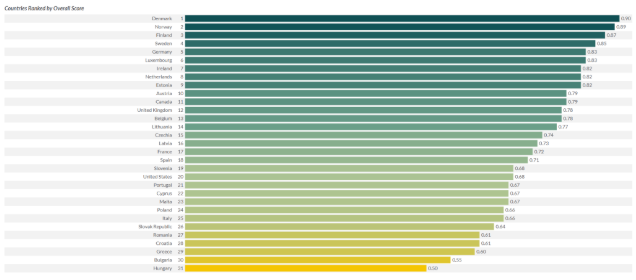
International rule of law indices have continued to decline among EU Member States over the past decade. Yet, the data also reveal a growing imbalance between high- and low-adherence countries. Based on these databases, the median rule of law score for all EU Member States declined between 2015 and 2024, from 0.73 to 0.72 according to the WJP (World Justice Project, 2024) and from 0.96 to 0.93 according to V-Dem (V-Dem Institute, 2024). Overall, the vast differences in the rule of law index scores of high-adherence countries and low-adherence countries have led to a phenomenon in which values at the extremes, such as Denmark’s overall WJP score of 0.90 and Croatia’s overall WJP score of 0.61, naturally balance out, yielding a stable long-run average trend.

The Hungarian rule of law Crisis
Since Viktor Orbán’s Fidesz party gained a supermajority in 2010, Hungary has frequently clashed with Brussels over judicial independence, media pluralism, and the balance of powers, all of which are key principles of EU law and values. In April 2023, Hungary released several foreign detainees who had been imprisoned for smuggling migrants (Botsford, 2025). Hungary argued that, in 2023, almost all prisons were over 100% full, with only a few between 90% and 100% (Katus, 2023), thereby justifying the release of migrant smugglers to reduce the prison burden. Conversely, the European Commission argues that Hungary is failing to honor the agreed position on strengthening EU law against people smuggling made on December 13th, 2024 (European Council, 2024). Prime Minister Orbán has also raised concerns about the overreach of rule of law enforcement in national politics and the conditionality of funds (Scheppele, 2024), a frequent concern given his obstructionism in EU foreign policy.
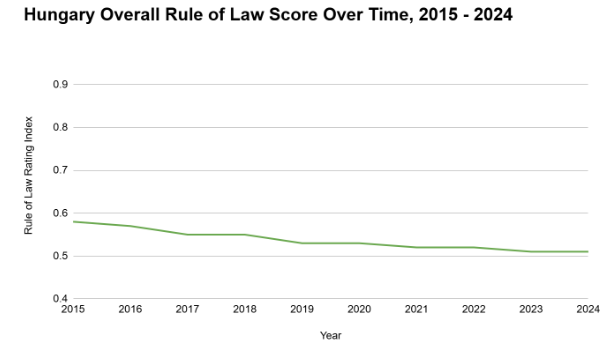
Additionally, on May 13th, 2025, a member of the Fidesz party submitted a bill titled ‘The Transparency in Public Life Bill’ (Human Rights Watch, 2025). The EU strongly criticizes the Transparency in Public Life Bill for two main reasons: first, civil society organizations (CSOs) must register and obtain authorization if they accept foreign funding; and second, the bill violates numerous provisions of the EU Charter of Fundamental Rights. Potential violations of the Transparency in Public Life Bill, if passed unchanged, include the free movement of capital, freedom of expression, freedom of association, and the right to adequate judicial protection. The Hungarian rule of law is frequently ranked lowest in the EU by the World Justice Project, with a score of 0.51 in 2024. Critically, despite numerous interventions and new policy instruments employed by the EU to reverse the downward trend of the rule of law in Hungary, the crisis remains an increasingly pressing issue.
The Polish Rule of Law Crisis
Led by the Law and Justice party since September 2015, the Polish government has differed from the requirements of Article 19(1) of the TEU, which states that “Member States shall provide remedies sufficient to ensure effective legal protection in
the fields covered by Union law.” On December 20, 2017, the European Commission triggered Article 7(1) of the TEU to protect judicial independence amid reforms in Poland, which subjected the judiciary to the political control of the ruling majority (Cuddy, 2017). Article 7 involves Case K 3/21 of 7 October 2021, a constitutional review by the Constitutional Tribunal of the TEU, which ruled in a 12-2 decision that all branches of power in Poland confirm that Poland’s membership in the EU does not entail the supreme legal authority of external institutions, such as the European Court of Justice (Gliszczyńska-Grabias & Sadurski, 2023).
Case K 3/21 demonstrates that constitutionalism, though well-intentioned, raises questions about whether EU law may override national constitutions, particularly in the interest of national sovereignty and validity. The main point of contention in Case K 3/21 was that Article 19, which establishes the European Court of Justice, empowers ordinary courts to disregard national constitutions by applying EU law over Polish law and challenging the constitutionality of national judicial appointments (Muttreja et al., 2023). The EU’s role in addressing the Polish rule of law crisis highlighted several shortcomings in the European Commission’s annual rule of law evaluations and enforcement mechanisms. The perceived clash between national constitutions and international law is a hallmark of constitutional pluralism. Additionally, constitutional pluralism has been criticized for its perceived abuse by Member States undergoing democratic backsliding, whereby national laws and traditions are accommodated without declaring the superiority of one legal system over the other (Racková, 2025). In Case K 3/21, the ultimate authority of Poland’s national constitution raised questions about whether a system in which different legal systems coexist fosters dialogue or division. Constitutional pluralism remains important to discussions of the rule of law, as it provides uncertain grounds for a Member State to select which EU law commitments to fulfill, given the ultimate authority of legal systems (Lasek-Markey, 2021).
In May 2024, the Article 7 procedure against Poland concluded after the European Commission analyzed Poland’s action plan and sustained commitments, withdrawing the reasoned proposal because there was no longer a clear risk of a serious breach of the rule of law (European Commission, 2025). Evidence of Poland’s policy change can be traced back to the Tusk-led coalition’s promise to reset Brussels-Warsaw relations and reverse the previous government’s policies against the rule of law. Poland achieved two super milestones: reforming the disciplinary regime for judges and replacing it with a new body, and reviewing the cases of the judges affected by the disciplinary chamber. This enabled Poland to unlock €6.3 billion in grants and loans and is well on track to achieve the remaining super milestones by the mid-2026 deadline (Liboreiro, 2024).
In particular, the Tusk-led coalition sought to exit the Article 7 procedure as soon as possible, as Poland was the largest recipient state of EU Cohesion Funds, which it relied on for many development projects (The Chancellery of the Prime Minister, 2023). Therefore, with the action plan submitted by Justice Minister Adam Bodnar, the pitch detailed nine bills aimed at restoring judicial independence from the highest tribunal to the most ordinary, and it was successful, representing a significant change achieved through EU policies (Liboreiro & Psara, 2024). As this paper aims to evaluate the current response to the EU rule of law crisis, Poland is examined as a case study to provide context on how the EU has responded to, and can respond to, rule of law breaches.
III. Key Policy Instruments, Enforcement Mechanisms, and Evaluations
The EU was founded on the principles of the rule of law, and it was widely assumed that Member States would be willing and able to integrate EU law into their national law. The EU’s toolbox for addressing and protecting the rule of law is somewhat mixed, comprising policy instruments and review mechanisms, all of which have been effective to some extent. As key treaties were being drafted, notably the TEU, issues such as democratic backsliding and restrictions on freedoms were likely unanticipated by the then-twelve Member States in 1992. Beyond policy instruments, the EU employs various diplomatic channels and recommendations to promote the rule of law, the most notable of which is the European Commission’s annual Rule of Law Report. The report serves as the primary mechanism for reviewing progress on the rule of law across Member States since 2020, both in positive and negative terms.
TEU Article 7 of the Treaty on European Union
Article 7 is commonly known as the nuclear option. This is because it is an infringement procedure to curb human rights abuses within the EU by threatening Member States that do not comply. Article 7 concerns the identification of breaches of the EU’s founding values, the imposition of sanctions, and voting rights. However, it is not possible to expel a Member State. Bureaucratic hurdles and hesitation constrain the effectiveness of Article 7. In March 2014, the European Commission adopted a three-step process for addressing breaches, comprising an assessment of the situation, a recommendation to be concerned about the accused Member State, and monitoring compliance (The European Commission, 2014). Moreover, the Article 7 process proceeds in three parts: Article 7(1) identifies the breach; crucially, actions against the accused Member State may not commence until Article 7(3).
The European Council’s path to Article 7(3) is not straightforward. To move beyond Article 7(2), which requires proof that the Member State has not heeded the recommendations, further guidance is discussed. Evidence of breaches of EU values and principles spans a wide range of EU reports, policies, and bodies; however, the key data for defining a breach of the rule of law are primarily drawn from the annual Rule of Law Report and the EU Justice Scoreboard. Both sources are quantitative, analyzing case backlogs, lengths of proceedings, and clearance rates, but they overlook key qualitative factors related to the actual perception of justice, which could contribute to the conclusion that such reporting mechanisms fail to produce results or conclusions that spur accusations and action.
Most importantly, Article 7(2) requires the European Council to decide whether to proceed to Article 7(3). The voting procedure under Article 7(3) requires a unanimous vote (excluding the accused Member State). These thresholds, though well-intentioned in their upholding of the principle that certain policy areas are subject to unanimity, allow known violators of the rule of law to rely on one another to evade suspension of their membership rights or other sanctions. Additionally, many Member States are hesitant to sanction or disenfranchise another Member State, especially when constitutional autonomy is at issue. According to constitutional pluralism, national constitutional law and EU law constitute a conceptual heterarchy, and voting to prioritize constitutional safeguards raises uncomfortable questions within the EU (Flynn, 2021). The interplay between geopolitical objectives and constitutional obligations reveals a structural uncertainty within the EU’s enforcement mechanisms: the effective transformation of Article 7, purported to be the ultimate, powerful last-resort procedure to protect the EU’s core values, into an expectation that is frequently circumvented by Member States seeking to contest the status quo.
Specifically, Article TEU 4(2) states that the EU shall respect the national identities inherent in the fundamental structures of Member States, such that certain aspects of their constitutional identity fall outside the domain of EU primacy, as the rule of law is merely an EU concept and not a model set in stone. Realistically, setting a precedent that questions the supremacy of EU law, or risking strained foreign relations, is what leads many Member States to approach Article 7(3) with caution rather than decisiveness in protecting EU values. In many cases, it is perceived as preferable to avoid Article 7 altogether. Cases such as the 2000 Austrian coalition with the far-right, the expulsion of thousands of Roma by France in 2009, and the 2012 political struggles in Romania are all examples of when Article 7 was considered. The reasoning behind the historically hesitant consideration of Article 7 is that, despite its name as a nuclear option, Article 7 cannot be wielded promptly or reliably. Given that Article 7 has been formally invoked only against Hungary and Poland, it is unclear whether, even if agreed upon, the rule of law is protected by the lengthy bureaucratic processes required to reach definitive action under Article 7(3).
Regarding the use of Article 7 against Hungary, discussions of its application lasted eight years, from 2010 to its activation in September 2018. During this period, the rule of law rating declined by approximately 14%, from 0.79 in 2010 to 0.68 in 2018 (See Figure 3),
underscoring the urgency of invoking Article 7 and the severity of prolonged inaction. Even so, the Article 7 process remains in limbo, with the most notable development being the General Affairs Council’s eighth hearing under Article 7(1) in May 2025 (General Affairs Council, 2025). As of March 2026, the European Council has yet to vote on whether there is a clear risk of a serious breach of the rule of law by Hungary. At the same time, the rule of law situation in Hungary is a growing issue for the EU day by day, including widely recognized breaches in anti-LGBTQ+ legislation, the Transparency in Public Life Bill, and an estimated 80% of Hungary’s media market resources controlled by Prime Minister Viktor Orbán’s Fidesz party (Lewing, 2025).
The threat of this nuclear option is troubling, as the prolonged rule of law crisis in Hungary strains the complex relationship between Hungary and the EU. The threat of this nuclear option remains contentious, as the prolonged rule of law crisis in Hungary complicates Hungary’s relationship with the EU. Hungary is one of the biggest recipient states in the EU, with primary benefits in funding, soft power, and freedom of movement (Yanatma, 2024). The strains in this relationship are portrayed in Hungarian state and pro-government media as a necessary sacrifice to protect Hungarian identity, with Fidesz’s political messaging framing the issue as a price to be paid for national self-determination (Benedek & Sebestyén, 2025). However, Member States remain optimistic that Hungary will eventually come to the negotiating table, citing the acceleration of the Article 7 procedure as an incentive to negotiate.
The appropriate policy instrument in this optimistic case is to disenfranchise immediately, as Hungary has historically used its veto powers to impede aid to Ukraine, bargain for a reduction in the blockage of EU budget funds, and slow progress on certain voting rights. All in all, Article 7, though complicated by bureaucracy and hesitation, is likely to be a solution as the EU grows ever frustrated with Hungary’s perceived misuse of the unanimity principle to veto and contest EU values and principles.

Rule of Law Conditionality Regulation
Given the loophole in TEU Article 7 on the EU’s values that could be exploited by Member States, the European Commission proposed in May 2018 to link EU budget allocations to adherence to the rule of law (Mańko et al., 2020). However, progress on the proposal was hindered by a reluctance to confront Hungary and Poland. Eventually, at the July 2020 European Council summit, it was agreed that the Multiannual Financial Framework and the Next Generation EU funds should be linked to a similar rule of law conditionality scheme proposed in 2018 (Drachenberg & European Council Oversight Unit, 2020).
The regulation was adopted on December 16th, 2020, following the specification of its interpretation, adoption, and implementation, which led Poland and Hungary to refrain from vetoing the regulation. The rule of law conditionality regulation takes targeted measures against continued breaches of the rule of law that are proven to be directly affecting/or seriously risk affecting the EU budget. Protective budget measures are outlined in the rule of law conditionality regulation, in Article 5(1)(b), which states: suspensions of commitments or payments, reductions of commitments through financial corrections or pre-financing, and an interruption of payment deadlines. Given that conditionality is rooted in a more budgetary approach, it could place greater pressure on continued breaches, particularly as the primary Member States concerned, Hungary and Poland, receive among the highest proportions of EU funding under cohesion policy. However, the rule of law conditionality regulation has proven effective in exerting pressure on violators of the rule of law. When faced with the financial threat of losing the stability provided by EU cohesion funds, Orbán’s government has pledged to take measures to protect the rule of law (Bayer, 2022). The extent to which such measures will be sustained is uncertain; however, reluctant concessions and pledges are a step forward.
A qualified majority voted in favor of applying the conditionality regulation against Hungary on December 15th, 2022. It froze €6.3 billion in cohesion and related funds received from the EU (Melchior, 2022), though this number has increased to around €18 billion in 2025 (Sorgi, 2025). Since the first use of the rule of law conditionality mechanism in 2022, Hungary has implemented several legislative and administrative measures in response to the EU’s recommendations, focusing on prosecutorial effectiveness, public transparency, and anti-corruption. The Hungarian government claims that the majority of these bills aim to strike a balance between national sovereignty and the rule of law, although Brussels does not wholly agree; in fact, some actions have faced significant criticism from other Member States. In addition to the previously mentioned ‘The Transparency in Public Life Bill’, Hungary has amendments that tighten political control over judicial appointments and court presidencies, which are widely criticized.
On June 1st, 2023, Hungary’s judicial reform package under Hungary’s Recovery and Resilience Plan entered into force (Novoszádek, 2023), increasing the powers of the National Judicial Council, amending the functions of the Supreme Court to reduce political influence, and protecting the right of national courts to refer preliminary questions to the Court of Justice of the EU. Contrary to the celebrations surrounding Hungary’s Recovery and Resilience Plan, it is well established that Hungary’s overall rule of law index has continued to decline, despite the pledges made. This is due to several factors, but the primary contributing factor is the weak immediate financial leverage of conditionality; despite having funds withheld, Hungary continues to access other forms of financial assistance, including funds from the Recovery and Resilience Facility.
Hungary has not fulfilled its commitments under the Recovery and Resilience Plan, as no meaningful change has been made since June 1st, 2023. The Recovery and Resilience Facility requires that all milestones and targets in the national plans be completed by August 2026, including strengthening the rule of law and judicial independence. Yet Hungary may not be able to receive the full payments from the Recovery and Resilience Facility, as all 27 super milestones, covering necessary and measurable improvements in areas such as the rule of law, anti-corruption, and public procurement safeguards, must be fully met to unlock them. The ruling majority in Hungary continues policies that weaken checks and balances, as the undermining of EU values to consolidate power is simply greater than the price of forfeiting EU payments. If anything, the fact that Hungary can still benefit from the Recovery and Resilience Plan’s grants despite CSOs’ detailed assessments of Hungary’s failure to comply with the preconditions for receiving EU benefits is proof enough that conditionality remains porous.
Alternatively, the rule of law conditionality raises concerns about unintended consequences, particularly regarding the media’s portrayal of budget cuts or payment suspensions. Once again, the question of constitutional pluralism arises, as selective compliance with conditionality mechanisms can be justified on the grounds that it protects constitutional identity. As constitutional pluralism is rooted in nationalism and the conflict between national and supranational identities, conditionality can be presented as an assault on sovereignty in constitutional traditions. By design, selective conditionality in Hungary’s Recovery and Resilience Plan employs threshold criteria that can be interpreted as upholding EU values, but rather enforcing arbitrary cut-offs in an act of political overreach.
Hungary’s state-controlled outlets have portrayed the most recent EU 2028–2034 spending plan to extend the link between funds and rule of law breaches with the following headlines: “Here is the plan, this is how Brussels will destroy our country” (Nemzet, 2025, para. 1), or “The Orbán government could lose hundreds of billions due to corruption in December” (Gergely, 2024, para. 1). While other Hungarian media outlets report on the situation from a neutral perspective, the presence of outlets that advance hostile narratives and delegitimize the EU as a supranational institution exacerbates the EU’s existing media disinformation crisis. Across the EU, contrasting portrayals of the Fidesz party politicizing the rule of law in favor of the ruling party by eroding checks and balances only serve to ignite state-controlled outlets to increase spending on political advertising.
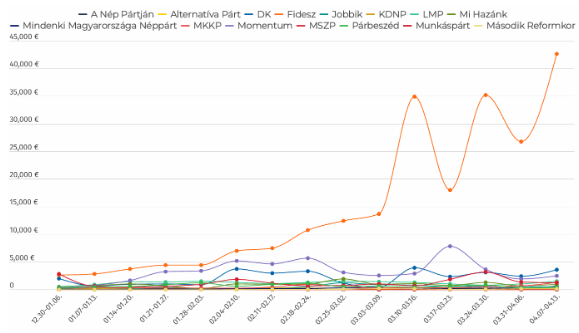
Formal discussions on strengthening ties between cohesion payments and the rule of law commenced in late 2022. It increased in frequency and likelihood between 2023 and mid-2024, until Hungary was blocked from receiving cohesion funds from June 26th, 2024 onwards (Mercédesz, 2024). This timeline aligns with a study on political advertising spending, which shows that the Fidesz Party dramatically increased its weekly political advertising expenditure as EU discussions shifted toward withholding cohesion funds to Hungary from December 31st, 2023, to April 6th, 2024.
IV. Policy Recommendations and Analysis
Addressing the rule of law crisis in Hungary and Poland requires key policy recommendations that acknowledge bureaucratic constraints, hesitation to act against Member States, and loopholes in existing policy instruments. Instead, this section will propose policy strategies to improve existing preventive and corrective approaches, specifically with respect to the pillars of efficiency, harmonisation, and civic society. The policies are evaluated against criteria of feasibility, effectiveness, political acceptability, cost, and equity.
1. Increasing the efficiency and effectiveness of Article 7
The first recommendation is to reorganize the EU Justice Scoreboard thematically around the four rule of law principles. An authoritative and evidentiary basis for Article 7 determinations can address the growing frustration among member states with the Article 7 procedure’s bureaucracy, underscoring the urgent need to streamline enforcement against clear, ongoing violations of the rule of law. This is highly feasible, as it would not require amending Article 7, but rather a methodological revision by the European Commission, with potential insights from similar projects, such as the annual report or independent work by the World Justice Project. Using thematic organization in the EU Justice Scoreboard can strengthen the link between quantitative data and compliance with the rule of law. Currently, as the EU Justice Scoreboard is a purely objective overview, organizing the overview into the six principles of the rule of law: legality, legal certainty, prohibition of the arbitrary exercise of executive power, effective judicial review, separation of powers, and equality before the law will identify with principles are being contested, highlight gaps in compliance, both done objectively through the specification of metrics and related principles.
An alternative approach is to require accused Member States to develop a process map that includes deliverables, deadlines, and quantifiable changes. The ability to cite quantitative and qualitative failures enables the establishment of additional procedural pathways or expedited hearings to take further action against a Member State that fails to advance the rule of law in accordance with the recommendations. Equity can be achieved through a process map that can be adjusted to align with the Member State’s targeted definitions of the rule of law and to adopt a stronger thematic focus. Prerequisites for equity in process maps require a multi-layered accountability system, as advocated by CSOs (Civil Society Europe, 2025). A prescriptive roadmap for restoration should balance the principle of equality between Member States (considering legal and constitutional context) with escalation thresholds to an expedited hearing at the General Affairs Council. However, the 7 years since Article 7 was triggered against Hungary, and after 8 hearings at the General Affairs Council, the procedure has stalled, underscoring the lack of procedural mechanisms to streamline voting and facilitate decisive action. This approach demonstrates mixed effectiveness: on the one hand, Poland’s successful exit from Article 7, and on the other, continued stalling in the General Affairs Council in Hungary’s case, contradict the successful precedent set by process maps.
2. Building trust and transparency to avoid politicization of the Rule of Law Toolbox
A key hurdle in the discussions surrounding Article 7 and the Conditionality Regulation is that accusations of politicization erode the political will needed to meet voting requirements and to use policy instruments decisively. According to von Bogdandy, the politicization of EU law and principles ultimately stems from concerns about the effectiveness of EU law (Von Bogdandy, 2018). In a political and economic union, establishing a shared understanding of laws and principles can be built only on trust. Increasing transparency and accountability can help avoid accusations of politicizing the Rule of Law toolbox. Recent instances in which the perception of the Rule of Law toolbox has soured include the alleged delay in publishing the 2024 Rule of Law Report to avoid upsetting Italy, and the timing of fund releases to Hungary during a vote on EU support for Ukraine (Csaky, 2024). Such incidents, whether true or false, have eroded trust between Member States and the EU.
It is also possible that vetoes regarding Article 7 or the Conditionality Regulation processes have gone unreported, as they occurred in an informal setting and are therefore not available as open-source data (Szép, 2023). The only reliable way to build trust is to demonstrate changes and take steps toward a peer-review process. Instead of raising concerns about politicization, embedding existing efforts to bolster independent media and civil society in the reporting process of a Member State’s compliance with issued recommendations or the annual Rule of Law Report. For example, if a vetted expert panel or committee consisting of relevant stakeholders, including independent media, civil society organizations, and national parliaments, were to fact-check findings, it would not only remove the possibility of misreporting rule of law situations but also contextualize and provide advice on better methodologies to draw truly transparent conclusions (Skóra, 2023). To draw on an example from a peer-review system outside the EU, since 2014, 83% of recommendations in peer reviews have been fully or partially implemented by Development Assistance Committee members of the OECD (Organisation for Economic Co-operation and Development, 2025). This would also create a multi-layered accountability system in which both domestic and international actors validate findings, thereby reducing the perception that the EU is imposing external judgments without local legitimacy.
A peer-review process that does not exclude national political actors conveys the broader message that the EU is unwilling to compromise on the need for increased monitoring of the rule of law crisis, but will do so without interfering in or misrepresenting domestic matters. By including national parliaments and civil society in the peer-review process, the EU can demonstrate that monitoring is collaborative rather than punitive, thereby reducing resistance from governments under scrutiny. However, equity cannot be guaranteed across all Member States due to Eurosceptic media, or, in some cases, state-controlled media, opposing measures such as Article 7.
This can be supplemented by expanding support for independent media and civil society organizations through increased EU funding, including direct grants, technical assistance, training workshops, and loans. Such measures would not only strengthen watchdog institutions but also foster a resilient information ecosystem capable of countering misinformation and Eurosceptic narratives. Countering misinformation is also high on the EU’s agenda, considering that Europe as a region is highly concerned about disinformation: 75% in the Netherlands and 76% in Poland view it as a top threat to democracy (Ipsos, 2025). The EU has already called for €5 million to bolster the European Fact-Checking Network (Directorate-General for Enlargement and Eastern Neighbourhood, 2025), and so addressing misinformation surrounding the Rule of Law Toolbox is just one of many concerns. Equity cannot be guaranteed across all Member States due to Eurosceptic media, or, in some cases, state-controlled media, opposing measures such as Article 7. As previously mentioned, Fidesz’s political advertising expenditure peaked at over €40,000 per week, quantifying the extent of potential asymmetry between the amount of misinformation and current EU countermeasures in Euroscepticism.
3. Strengthening the link between the rule of law and the EU budget through conditionality
The Conditionality Regulation is the latest addition to the rule of law toolbox. It has been effective in exerting greater pressure on the current state of the rule of law in Hungary by withholding €18 billion. The advancement of conditionality should be directly linked to failures to meet recommendations or threshold criteria, thereby strengthening the link between poor compliance with EU guidelines and financial penalties. Examples of EU-financed assistance linked to rule of law compliance include programs, grants, and loans.
Additionally, introducing a fast-track procedure or mechanisms that gradually increase the degree of payments withheld can pressure targeted Member States to deliver meaningful results promptly, rather than allowing time to identify alternative loopholes in the sourcing of financial payments. In practice, what fast-track procedures could look like in the Recovery and Resilience Plan, for example, a plan for a multi-tier withholding policy that increases in severity with the failure to meet milestones, should be well-established before the first payments to the Member State. Therefore, fast-tracking and increasing the severity of financial penalties, if a precedent for more proactive and streamlined withholding of funds were to be established for most EU funding sources, would result in much greater deterrence. The correlation between the rule of law and the withholding of EU funds should be made much more transparent and accessible to all EU citizens to avoid the risk that state media portrays the link as an attack or an unjust overreach. Beyond establishing this fact in the Rule of Law Report, it should also be made clear in publications related to every instance of EU-funded assistance, including impact reports, assessments, implementation reports, and the website.
Commissioner Serafin noted that, regarding Hungary and the conditionality regulation, “ [in] exactly in two weeks’ time, at the end of the year, unfortunately, because of lack of notification from the Hungarian government, another 1 billion euro from cohesion funds will be decommitted.” This statement from December 2025 (Serafin, 2025) shows that, despite the comprehensive Rule of Law Toolbox, the transparency of the conditions, and the continued freezing of funds, the status quo has objectively worsened. This appears to be a procedural notification lapse and a gap in monitoring under the current conditionality framework. Therefore, embedding specific, agreed-upon, and transparent pathways to a fast-track Article 7 procedure/penalty mechanism can, at the very least, penalise Member States for continuing to disregard their minimum obligations.
V. Alternative Policies
The recommendations presented as alternative policies are by no means infeasible or ineffective; however, this paper will outline the risks associated with such approaches to provide a more comprehensive review of possible solutions to the rule of law crisis. Both the modification of Article 7 to a qualified majority voting requirement and its parallel activation are constrained by the same political and legal barriers that complicate the use of Article 7 in the first place. Until the political will to act decisively against rule of law violations can be secured, the prerequisite of a depoliticized Article 7 procedure cannot be met, and likewise, the political will to drastically change the fundamentals of Article 7 cannot be secured.
1. Modifying Article 7 to a qualified majority voting (QMV) requirement instead of a unanimous requirement

A relatively straightforward approach to reducing the strictness of the current voting requirements in Article 7 is frequently cited as a means of addressing the rule of law crisis. However, in practice, it is a complex process both legally and politically. The unanimous voting requirement outlined in Article 7 is widely regarded as the principal barrier to its effectiveness, as political gridlock has prevented even a four-fifths majority from acting against Hungary. Of course, simply removing the unanimous vote to proceed to Article 7(3) would be highly controversial, since critics argue that sanctioning rule of law violations infringes on sovereignty and national constitutional identity. While a qualified majority (55% of countries, 65% of the population) may eliminate the immediate possibility that known violators of the rule of law exploit unanimous voting to evade repercussions, this process still requires, once again, a unanimous decision to ratify the modification of the TEU. Certain exceptions under Article 31, which established that decisions shall be made through unanimity, which explicitly exclude a qualified majority when a decision has ‘military or defence implications’; therefore, a ratification of Article 7 procedure is unlikely. There is a fundamental feasibility constraint when the mechanism needed to lower voting thresholds is subject to the same political volatility.
Debates over changing voting requirements have intensified, particularly among the Group of Friends on Qualified Majority Voting, to enhance pragmatic, efficient decision-making in the EU by eliminating the unanimity requirement for key foreign policy issues. By contrast, other supranational blocs have already adopted QMV to impose sanctions and punishments on member states for unconstitutional changes of government. In the African Union, for example, QMV has increased the frequency of sanctions, enabling the Peace and Security Council to suspend Burkina Faso, Gabon, Guinea, Mali, and Niger. The committee’s ability to swiftly move into suspension, without political deadlock from the sanctioned states, has resulted in a 91% suspension rate among the 22 cases handled since 2005 (Andrews Atta-Asamoah, 2022). However, increasing the frequency of sanctions does not necessarily translate into positive political transitions, meaningful rule of law developments, or long-term deterrence. In several cases, specifically in the African Union, sanctioned and/or suspended states have continued to violate democratic norms or have re-admitted coup leaders into government, undermining the credibility of a fast-track suspension mechanism. While QMV undoubtedly facilitates faster and greater volume of decision-making, it is only part of the solution to guaranteeing compliance and democratic restoration. When considering the case of the African Union in the European rule of law crisis, it becomes clear that extensive measures to tackle bureaucracy, ensure consistent review, and impose fiscal costs on potential violators throughout rule of law enforcement are what truly determine the practicality of suspensions and sanctions.
Moreover, removing the unanimity requirement would raise significant questions that could undermine the EU’s legitimacy. After all, the EU was founded on the core principle of unity, which helps explain why unanimity, though widely recognized as highly bureaucratic, has persisted since the Union’s inception. Any move toward QMV under Article 7, even amid growing support from the Group of Friends on Qualified Majority Voting, would inevitably face resistance. A highly compelling case for abandoning unanimity in Article 7 would be needed to convince Member States such as Hungary and similarly aligned countries like Bulgaria, Italy, Poland, Romania, Slovakia, and Croatia, all of which declined to sign the declaration calling for a formal warning to Hungary over its anti-LGBT+ measures under Article 7(1). As a result, political feasibility for this policy is called into question when only 20 of the necessary 26 Member States supported the declaration (European Pravda, 2025), which adds a layer of uncertainty in whether a hypothetical qualified majority system would sway enough votes to move forward in the Article 7 process, with the risk of political divisions and sovereignty concerns persisting in impeding Article 7. Before embarking on the legally and politically complex task of amending the Treaty on European Union to abolish unanimity in future Article 7 procedures, the EU should first secure the qualified majority currently lacking among Member States. These include those reluctant to set a precedent that could later be turned against them, and those who have strategic reasons, whether political, economic, or foreign policy-related, for shielding Hungary from disenfranchisement.
2. Parallel activation of Article 7 against two or more Member States violating EU values and principles
Contrary to the policy recommendations, parallel activation seeks to reinterpret the procedure and its loopholes. In an article by distinguished legal scholars (Kochenov et al., 2017), it is argued that the rule of law crisis was exacerbated by the EU’s failure to address it in Hungary and subsequently in Poland. At the time the article was written, before the activation of Article 7 against Hungary and the emergence of rule of law conditionality, the assumption was that the Article 7 procedure would be much less bureaucratic and could reach the sanctioning stage beyond Article 7(1). However, it raises an interesting alternative to addressing the lack of political will among Member States to vote against another, even in a clear rule of law crisis. In cases involving more than one Member State, initiating Article 7 proceedings against them in parallel directly eliminates the risk that they can protect one another through vetoes that would prevent a unanimous vote. This would effectively neutralize the mutual veto protection without actually having to go through the politically challenging route of changing voting requirements.
Of course, the concern with such a solution is that it will be heavily criticized by Member States that wish to exercise their veto, and there is a high likelihood that the parallel activation of Article 7 would be challenged before the Court of Justice of the European Union. As such, a different political feasibility issue arises as more bilateral relations become variables in determining whether parallel activation can even begin. As the court generally upholds fundamental values in its judgments, the relevance of unity is undermined by the exclusion of Member States, which can be argued to be unjust or, at the very least, a threat to the precedents set in Article 7, as simultaneous procedures risk further bureaucracy in its application.
VI. Implementation Plan
Firstly, the priority should be to halt the ongoing decline of the rule of law by further strengthening the link between the rule of law and the EU budget through conditionality. The European Commission should have the most direct role in this step of implementation, liaising with different EU funds beyond cohesion and the Recovery and Resilience Facility to enforce strict audits, as the Commission has authorized reimbursement up to approximately €10.2 billion, which remains a financial buffer that weakens deterrence. To overcome any legal or political setbacks to broadening the scope of conditionality, the Commission should stick to stricter and clearer protocols for milestone criteria in process maps. This is because the Commission would not have to rely on shaky political will to amend treaties and would be able to finish this task quickly (relative to alternative policies like parallel activation or QMV. Another area of conditionality expansion is the need to address ongoing procedural notification lapses and gaps in monitoring administrative concerns. Recalling Commissioner Serafin’s statement, there should be a tiered conditionality system that combines thematic focuses to streamline Article 7 and fast-track procedures to withhold payments, because there is a clear distinction between declines in the rule of law and failures to remain transparent about compliance notifications. The Commission may establish process maps in the future where unfreezing of funds will only occur if a Member State meets all administrative requirements, such as communicating mid-year and annual progress according to reporting standards, and all compliance requirements, like demonstrating the impacts of passed legislation aimed at improving the thematic focuses of the rule of law, with quantifiable impacts verified by the same stakeholders involved in the Rule of Law Report consultation: CSOs, media organizations, and professional associations. Otherwise, there could be an audit in which the Commission can then very clearly and transparently cite specific thematic areas where the Member State is falling behind EU standards, automatically arranged should the Member State fail to notify progress. The Commission may also remain open to input from the stakeholders consulted for the Rule of Law Report.
Upon measurable progress through the corrective approach, with at least half of the super milestones achieved, and a verified improvement in all six aspects of the Rule of Law via increased involvement (monetary support, frequent communication channels in consultations) from both the Commission and external stakeholders, the preventative approach may proceed. Hastily switching to the corrective approach may prove contradictory. For example, if funds were reimbursed based on the formal fulfillment of legislative milestones and the Commission pivoted to policies aimed at countering misinformation or increased funding for civil society grants, it would risk creating a precedent that legal checklists alone can satisfy conditionality. This is precisely the message that can reiterate that procedural compliance will resolve concerns, which, in the long run, proves harmful to the rule of law, as funds are unblocked without genuine improvement. The Commission should establish a clearly defined threshold before preventive investment, determined by strengthening monitoring of the human rights impact of legislative reforms. Next, the Commission should increase support for independent media and civil society organizations through higher EU funding, including direct grants, technical assistance, training workshops, and loans. These measures would not only strengthen watchdog institutions but also promote a resilient information ecosystem capable of countering misinformation.
VII. Conclusion
The ongoing rule of law crisis poses numerous challenges for the EU. The actual test lies in developing policies and mechanisms that require decisive action now more than ever to establish resilient frameworks grounded in the rule of law, given the political uncertainty sparked by the remarkable year of 2024, marked by unexpected electoral turmoils and shifting political landscapes across Europe. Democracy in the EU is now facing both internal and external pressures, and the EU must critically assess its rule of law toolbox to uphold EU values and principles across civil society, the economy, and cohesion. However, by analyzing why Article 7 is no longer the nuclear option once thought, how conditionality can drive further politicization of the rule of law, and the need to create a more comprehensive correlation between compliance and the EU budget, the EU can move from a somewhat disconnected rule of law toolbox to one that leaves no room for question or loopholes. Although concerns may remain about the wording or strict voting requirements of Article 7, the near future should prioritize compliance over the complexities of political will in EU voting. This is just one of many hurdles the EU must overcome to move beyond the tumultuous times of post-COVID recovery and growing Euroskepticism, addressing the rule of law crisis proves to both Europe and the world that the EU can be a force of cohesion and shared values, a sentiment many Member States would agree that it is appropriate to protect a united reputation as the strongest supporter and defender of the liberal international order.
VIII. References
Andrews Atta-Asamoah. (2022, September 14). The AU prepares to wield the stick with more rigorous sanctions. ISS Africa. Retrieved March 29, 2026, from https://issafrica.org/iss-today/the-au-prepares-to-wield-the-stick-with-more-rigorous-sanctions
Bayer, L. (2022, November 9). Don’t fall for Orbán’s promises: EU gets warning as funding deal nears. POLITICO. https://www.politico.eu/article/viktor-orban-hungary-europe-dont-fall-for-promises-eu-gets-warning-as-funding-deal-nears/
Benedek, I., & Sebestyén, A. (2025). Euroambivalent and Equivocal Euroscepticism: Two Shades of Strategic Ambiguity in the 2024 European Parliament elections in Hungary. Politologický Časopis - Czech Journal of Political Science, 2, 190–221. https://doi.org/10.5817/pc2025-2-190
Botsford, P. (2025, June 18). Rule of Law: EU blocking €18bn funding to Hungary over legislation concerns. International Bar Association. Retrieved August 8, 2025, from https://www.ibanet.org/Rule-of-law-EU-blocking-18bn-funding-to-Hungary-over-legislation-concerns
Civil Society Europe. (2025). Joint Civil Society Contribution on Civic Space to the 2025 Rule of Law Report. In Civil Society Europe. Retrieved March 29, 2026, from https://civilsocietyeurope.eu/wp-content/uploads/2025/06/Joint-Civil-Society-Contribution-on-Civic-Space-to-the-2025-Rule-of-Law-Report.docx.pdf
Csaky, Z. (2024, October 7). The EU and the rule of law: Much movement, little change. Centre for European Reform. Retrieved August 23, 2025, from https://www.cer.eu/insights/eu-and-rule-law-much-movement-little-change
Cuddy, A. (2017, December 20). What is ‘Article 7’ and why was it triggered against Poland? Euronews. https://www.euronews.com/2017/12/20/what-is-article-7-and-why-was-it-triggered-against-poland-
Directorate-General for Enlargement and Eastern Neighbourhood. (2025, May 27). Commission launches €5 million call to strengthen European Fact-Checking Network. Enlargement and Eastern Neighbourhood. Retrieved March 29, 2026, from https://enlargement.ec.europa.eu/news/commission-launches-eu5-million-call-strengthen-european-fact-checking-network-2025-05-27_en
Drachenberg, R. & European Council Oversight Unit. (2020). Outcome of the special European Council meeting of 17-21 July 2020. In European Parliamentary Research Service (Report PE 654.169). https://www.europarl.europa.eu/RegData/etudes/BRIE/2020/654169/EPRS_BRI(2020)654169_EN.pdf
European Commission. (2021). Rule of Law: Commission launches infringement procedure against Poland for violations of EU law by its constitutional Tribunal. In European Commission (IP/21/7070). Retrieved August 3, 2025, from https://ec.europa.eu/commission/presscorner/api/files/document/print/en/ip_21_7070/IP_21_7070_EN.pdf
European Commission. (2024). Hungary’s recovery and resilience plan. Retrieved August 14, 2025, from https://commission.europa.eu/business-economy-euro/economic-recovery/recovery-and-resilience-facility/country-pages/hungarys-recovery-and-resilience-plan_en
European Commission. (2025, February 6). Timeline - Article 7: the story so far. Retrieved August 21, 2025, from https://www.consilium.europa.eu/en/policies/article-7-procedures/timeline-the-story-of-article-7/
European Council. (2024, December 13). Migrant smuggling: Member States reach agreement on criminal law. Council of the EU. Retrieved August 4, 2025, from https://www.consilium.europa.eu/en/press/press-releases/2024/12/13/migrant-smuggling-member-states-reach-agreement-on-criminal-law/pdf
European Parliamentary Research Service. (2019, December 20). voting system in Council. Epthinktank. https://epthinktank.eu/2019/12/20/council-of-the-european-union-facts-and-figures/voting-system-in-council/
European Pravda. (2025, May 28). Will Hungary lose its EU veto power and which countries oppose it. European Pravda. https://www.eurointegration.com.ua/eng/news/2025/05/28/7212591/
European Union. (2016). Consolidated version of the Treaty on European Union TITLE III - PROVISIONS ON THE INSTITUTIONS Article 19. Official Journal of the European Union, C 202/27, 12016M019. http://data.europa.eu/eli/treaty/teu_2016/art_19/oj
Flynn, T. (2021). Constitutional pluralism and loyal opposition. International Journal of Constitutional Law, 19(1), 241–268. https://doi.org/10.1093/icon/moab035
General Affairs Council. (2025, May 27). General Affairs Council, 27 May 2025 [Press release]. Retrieved August 23, 2025, from https://www.consilium.europa.eu/en/meetings/gac/2025/05/27/
Gergely K. K. (2024, September 27). Százmilliárdokat bukhat a korrupció miatt az Orbán-kormány decemberben. 24.hu. https://24.hu/fn/gazdasag/2024/09/26/eu-unios-forras-eb-rrf-befagyasztas-orban-kormany-korrupcio/
Gliszczyńska-Grabias, A., & Sadurski, W. (2023). Is it Polexit yet? Comment on Case K 3/21 of 7 October 2021 by the Constitutional Tribunal of Poland. European Constitutional Law Review, 19(1), 163–181. https://doi.org/10.1017/s1574019622000396
Hanelt, E. (2024). Getting Article 7 done: coalition-building against Hungary in the European Parliament. Journal of European Integration, 1–22. https://doi.org/10.1080/07036337.2024.2441977
Hervey, G., & Livingstone, E. (2017, December 20). What is Article 7? POLITICO. https://www.politico.eu/article/hungary-eu-news-article-7-vote-poland-rule-of-law/
How Hungary’s Orbán uses control of the media to escape scrutiny and keep the public in the dark | AP News. (2024, July 31). AP News. Retrieved August 4, 2025, from https://apnews.com/article/hungary-media-democracy-orban-magyar-european-parliament-f6315d7cc252f210c360863de403054e
Human Rights Watch. (2025, May 23). Open letter on the Hungarian bill entitled “Transparency of Public Life.” Human Rights Watch. Retrieved August 4, 2025, from https://www.hrw.org/news/2025/05/23/open-letter-hungarian-bill-entitled-transparency-public-life
Hungary’s recovery and resilience plan. (2023). European Commission. Retrieved August 5, 2025, from https://commission.europa.eu/business-economy-euro/economic-recovery/recovery-and-resilience-facility/country-pages/hungarys-recovery-and-resilience-plan_en#rrf-funded-projects-in-hungary
Ipsos. (2025, November 20). The State of Democracy 2025: Fake news, lack of accountability, extremism and corruption seen as top threats to democracy across Europe and the US. Ipsos. https://www.ipsos.com/en-nl/state-democracy-2025-fake-news-lack-accountability-extremism-and-corruption-seen-top-threats
Jakab, A., & Kirchmair, L. (2021). How to Develop the EU Justice Scoreboard into a Rule of Law Index: Using an Existing Tool in the EU Rule of Law Crisis in a More Efficient Way. German Law Journal, 22(6), 936–955. https://doi.org/10.1017/glj.2021.46
Katus, E. (2023, March 8). Hungarian prisons are overcrowded, there have never been so many behind bars. English. Retrieved August 4, 2025, from https://english.atlatszo.hu/2023/03/06/hungarian-prisons-are-overcrowded-there-have-never-been-so-many-behind-bars/
Kochenov, D. V., Pech, L., & Scheppele, K. L. (2017, December 23). The European Commission’s activation of Article 7: Better late than never? Verfassungsblog. Retrieved August 24, 2025, from https://doi.org/10.17176/20171223-131736
Lasek-Markey, M. (2021). Poland’s Constitutional Tribunal on the status of EU law: The Polish government got all the answers it needed from a court it controls. European Law Blog. https://doi.org/10.21428/9885764c.50f3c7b7
Lewing. (2025, May 30). Hungary’s legal challenge: A clash between EMFA and state-controlled media. Edinburgh Europa Institute. Retrieved August 14, 2025, from https://europa.sps.ed.ac.uk/2025/05/30/hungarys-legal-challenge-a-clash-between-emfa-and-state-controlled-media/
Liberties. (2025). Liberties Rule of Law Report 2025. Civil Liberties Union for Europe. Retrieved August 4, 2025, from https://www.liberties.eu/f/vdxw3e
Liboreiro, J. (2023, May 4). Nine EU countries join forces to reform voting rules on foreign policy and dent veto power. Euronews. https://www.euronews.com/my-europe/2023/05/04/nine-eu-countries-join-forces-to-reform-voting-rules-on-foreign-policy-and-dent-veto-power
Liboreiro, J. (2024, February 29). Breaking down the €137 billion in EU funds that Brussels has unfrozen for Poland. Euronews. Retrieved August 23, 2025, from https://www.euronews.com/my-europe/2024/02/29/breaking-down-the-137-billion-in-eu-funds-that-brussels-has-unfrozen-for-poland
Liboreiro, J., & Psara, M. (2024, February 20). Poland pitches way out of Article 7 as Brussels hails “positive dynamic.” Euronews. Retrieved August 22, 2025, from https://www.euronews.com/my-europe/2024/02/20/poland-pitches-way-out-of-article-7-as-brussels-hails-positive-dynamic
Mańko, R., Sapała, M., & European Parliamentary Research Service. (2020). Protecting the EU budget against generalised rule of law deficiencies. In EU Legislation in Progress. https://www.europarl.europa.eu/RegData/etudes/BRIE/2018/630299/EPRS_BRI(2018)630299_EN.pdf
Melchior, S. (2022, December 15). Explainer: Europe cuts off funds for Hungary - what is at stake? Investigate Europe. Retrieved August 14, 2025, from https://www.investigate-europe.eu/en/posts/explainer-europe-cuts-off-funds-for-hungary-what-is-at-stake
Mercédesz, H. (2024, December 4). Hungary has not received EU cohesion funds for 161 days. Daily News Hungary. Retrieved August 23, 2025, from https://dailynewshungary.com/hungary-eu-cohesion-funds-161-days/
Mstratenwerth. (2024, December 16). Funds for Hungary remain frozen. Daniel Freund. Retrieved March 29, 2026, from https://danielfreund.eu/funds-for-hungary-remain-frozen/?lang=en
Muttreja, I., Auer, S., & Scicluna, N. (2023, May 17). The EU must face up to its rule of law crisis. Chatham House. Retrieved August 4, 2025, from https://www.chathamhouse.org/2023/05/eu-must-face-its-rule-law-crisis
Nemzet M. (2025, July 11). Íme a terv, így sarcolja meg hazánkat Brüsszel. Íme a Terv, Így Sarcolja Meg Hazánkat Brüsszel. https://magyarnemzet.hu/kulfold/2025/07/brusszel-europai-unio-koltsegvetes-magyarorszag-eu
Novoszádek, N. (2023, May 23). Assessment of Hungary’s judicial reforms - Hungarian Helsinki Committee. Hungarian Helsinki Committee. Retrieved August 14, 2025, from https://helsinki.hu/en/assessment-of-hungarys-judicial-reforms/
OJ L 433I 22.12.2020, p. 1. (2020, December 22). EUR-Lex. Retrieved August 5, 2025, from https://eur-lex.europa.eu/legal-content/EN/TXT/?uri=CELEX%3A02020R2092-20201222
Organisation for Economic Co-operation and Development. (2025). Development co-operation peer reviews and learning. Organisation for Economic Co-operation and Development. Retrieved March 29, 2026, from https://www.oecd.org/en/topics/development-co-operation-peer-reviews-and-learning.html
Pech, L. (2022). The rule of law as a Well-Established and Well-Defined Principle of EU Law. Hague Journal on the Rule of Law, 14(2–3), 107–138. https://doi.org/10.1007/s40803-022-00176-8
Political Capital Policy Research and Consulting Institute. (2024). Pro-government political advertisements are in record heights in Hungary, promoting hostile narratives against the West. https://politicalcapital.hu/pc-admin/source/documents/pc_in-depth_analysis_Pro-government_political_advertisements_are_in_record_heights_in_Hungary_promoting_hostile_narratives_against_the_West_20240425.pdf
Racková, N. (2025). Constitutional Pluralism in Times of the Rule of Law Crisis: Susceptible to Abuse? European Law Blog. https://doi.org/10.21428/9885764c.b9cba2c8
Scheppele, K. L. (2024, August). Inside Orbán’s Plan to Occupy Europe. Journal of Democracy. Retrieved August 23, 2025, from https://www.journalofdemocracy.org/online-exclusive/inside-orbans-plan-to-occupy-europe/
Serafin, P. (2025, December 17). Remarks by Commissioner Serafin during the European Parliament plenary debate about the implementation of the rule of law conditionality regime. Piotr Serafin, Strasbourg, France. https://ec.europa.eu/commission/presscorner/detail/en/speech_25_3128
Skóra, M. (2023). How to improve the EU’s rule of law toolbox. In Friedrich-Ebert-Stiftung. Friedrich-Ebert-Stiftung. Retrieved August 21, 2025, from https://library.fes.de/pdf-files/bueros/bruessel/20380.pdf
Sorgi, G. (2025, July 11). Brussels pushes to block budget payouts to EU’s democratic backsliders. POLITICO. https://www.politico.eu/article/brussels-belgium-eu-democratic-payouts-standards-hungary-governments/
Szép, V. (2023, May 2). Making EU Foreign Policy More Effective: Qualified Majority Voting on the Horizon? Carnegie Endowment for International Peace. Retrieved August 23, 2025, from https://carnegieendowment.org/europe/strategic-europe/2023/05/making-eu-foreign-policy-more-effective-qualified-majority-voting-on-the-horizon?lang=en
The Chancellery of the Prime Minister. (2023, February 8). Inauguration of the new EU financial perspective 2021-2027 - almost PLN 350 billion for Poland. Retrieved August 23, 2025, from https://www.gov.pl/web/primeminister/inauguration-of-the-new-eu-financial-perspective-2021-2027---almost-pln-350-billion-for-poland
The European Commission. (2014). COMMISSION RECOMMENDATION of 12 March 2014 on a new approach to business failure and insolvency. Official Journal of the European Union, 74(2014/135/EU), 65–70. https://eur-lex.europa.eu/legal-content/EN/TXT/PDF/?uri=CELEX:32014H0135
V-Dem Institute. (2024). Country Graph – V-Dem. Retrieved August 3, 2025, from https://v-dem.net/data_analysis/CountryGraph/
Von Bogdandy, A. (2018). Ways to frame the European rule of law: Rechtsgemeinschaft, trust, Revolution, and Kantian Peace. European Constitutional Law Review, 14(4), 675–699. https://doi.org/10.1017/s157401961800041x
Von Der Leyen, U. (2019). A Union that strives for more. In European Commission. Retrieved August 23, 2025, from https://commission.europa.eu/document/download/063d44e9-04ed-4033-acf9-639ecb187e87_en?filename=political-guidelines-next-commission_en.pdf
Wigler, M. (2023). Can the European Union effectively protect the rule of law in its member states?: Evaluating enforcement tools in the context of Poland and Hungary. In S. Fina & R. Vogl (Eds.), European Union Law Working Papers (No. 78). Stanford Law School and University of Vienna School of Law. Retrieved August 4, 2025, from https://law.stanford.edu/wp-content/uploads/2023/05/EU-Law-WP-78-Wigler.pdf
WJP Rule of Law Index. (n.d.). Retrieved March 29, 2026, from https://worldjusticeproject.org/rule-of-law-index/global/2025
World Justice Project. (2024). WJP Rule of Law Index - Hungary. Retrieved August 4, 2025, from https://worldjusticeproject.org/rule-of-law-index/country/2024/Hungary/
Yanatma, S. (2024, December 9). EU budget: Who pays the most into the EU, and who gains the most? Euronews. https://www.euronews.com/business/2024/12/09/eu-budget-who-pays-the-most-into-the-eu-and-who-gains-the-most