.jpg)
.jpg)
.jpg)
.jpg)


.svg)


.svg)
Abstract
Historically Black Colleges and Universities (HBCUs) represent a small share of U.S. postsecondary institutions yet produce a disproportionately high number of Black graduates in STEM and the research workforce. Despite this impact, federal research funding to HBCUs remains significantly lower than that of predominantly white institutions (PWIs). This study analyzes fifteen years of federal grant data from the NSF, NIH, DOE, and Department of Education, paired with interviews with HBCU faculty and administrators, to examine disparities in award rates, total funding received, and institutional research capacity. Findings demonstrate that systemic inequities suppress HBCU research participation through cycles of underfunding, heavier teaching loads, administrative undercapacity, and biases in peer review. Policy reform recommendations include equity-focused funding streams, restructured merit review criteria, federal mentorship initiatives, and expanded agency accountability structures. Without substantive change, disparities in HBCU grant utilization will continue to impoverish not only the institutions themselves but the nation’s broader innovation capacity. Equitable investment in HBCUs must be recognized as both a matter of social justice and a strategic priority for U.S. competitiveness in the global knowledge economy.
Introduction
Since their inception in the mid-to-late nineteenth century, HBCUs have served as an enduring response to systemic racial exclusion within American education. From Howard University’s founding in 1867 to land-grant HBCUs established following passage of the Second Morrill Act of 1890, these institutions were built not out of generosity from existing state systems but as separate, often underfunded, alternatives to segregationist practices. More than 150 years later, HBCUs continue to deliver on their central mission: expanding access to higher education and opportunity for African Americans and other historically marginalized populations.
The numbers are striking. Today, HBCUs represent roughly 100 accredited institutions across the United States, yet their impact on the Black professional class is disproportionate. According to the Thurgood Marshall College Fund (2021):
- 40% of Black engineers,
- 50% of Black lawyers,
- 80% of Black judges, and
- 50% of Black teachers
received degrees from HBCUs. In STEM, which is tightly linked to federal research grants, HBCUs account for only a sliver of overall national R&D spending but are foundational training grounds for Black scientists.
Despite their broad social impact, HBCUs are marginalized in grant funding systems. Federal funding inequalities persist even as national policy rhetoric repeatedly celebrates HBCUs’ importance. Between 2010 and 2020, NSF awarded approximately $450 billion in grants across U.S. higher education institutions. Yet HBCUs collectively captured only about $400–500 million of that total—less than 0.2 percent. NIH mirrors this imbalance: a 2022 NIH equity report showed Black investigators’ application success rates at 16.1 percent, compared with 29.3 percent for white applicants (National Institutes of Health, 2022). Given the large representation of Black faculty researchers at HBCUs, such disparities compound institutional disadvantage.
HBCUs consistently produce strong student outcomes relative to their limited resources. However, the pattern of unequal funding points to a systemic issue: current allocation practices unintentionally reinforce cycles of advantage for already well-funded institutions, making it harder for emerging or under-resourced universities to compete. (Merton, 1968). Federal grant review frameworks often reward existing infrastructure, prior award history, and perceived institutional capacity, which structurally benefits wealthy PWIs with multi-billion-dollar endowments and established research ecosystems. As a result, an HBCU with minimal grant-writing staff and limited lab facilities is evaluated against the same criteria as an institution with multiple federally funded research centers. The inequity is thus obscured by the formal language of “merit,” despite being structurally predetermined.
This paper aims to address these inequities systematically. Specifically, it addresses:
- How does federal research and education grant funding to HBCUs compare with that directed to PWIs with comparable size and mission?
- What structural, institutional, and cultural barriers shape HBCUs’ lower rates of federal award utilization?
- How do funding disparities affect research productivity, student pipelines into advanced careers, and faculty development?
- What policy interventions can foster equitable access and capacity-building for HBCUs?
By combining a quantitative analysis of federal award allocations with qualitative interviews at three representative HBCUs, this study provides both empirical evidence of disparity and narrative context for systemic reforms. Ultimately, it argues that addressing HBCU underfunding is not simply about righting past wrongs but about ensuring the nation draws from its full pool of intellectual talent in STEM, social sciences, and education.
Historical Context: The Long Shadow of Segregation in Higher Education Funding
The history of funding inequities facing HBCUs cannot be disentangled from the broader racialized trajectory of American higher education. HBCUs were created within an explicitly segregated system: the Morrill Act of 1862, which granted federal land and resources to establish universities, excluded Black students almost entirely. Only with the Second Morrill Act of 1890 were states required to either desegregate existing land-grant institutions or establish separate colleges for Black students. The majority chose separation, leading to the founding or incorporation of what are now called the “1890 land-grant HBCUs,” including institutions such as Tuskegee University and Florida A&M University.
This separate-but-unequal framework shaped the funding landscape from the beginning. While these institutions were expected to fulfill the same mission as their white counterparts—advancing agriculture, engineering, and research—they were never provided proportional resources. A 2019 Hechinger Report analysis found that in nearly every state with both an 1862 and 1890 land-grant university, state appropriations per student to the HBCU ranged from one-half to two-thirds of the funding provided to the white land-grant institution. In Maryland, for example, the 2018 state allocation amounted to roughly $32,000 per student at the University of Maryland, compared to $16,000 at the University of Maryland Eastern Shore. This sustained resource gap has eroded HBCUs’ infrastructure, research capacity, and long-term financial stability.
Court cases and Department of Justice interventions have repeatedly exposed these inequities. In Ayers v. Fordice (1992), Mississippi was found to have maintained a dual, unequal higher education system long after desegregation, prompting a landmark settlement. Likewise, in Coalition for Equity and Excellence in Maryland Higher Education v. MHEC (2013), the court ruled that program duplication at predominantly white institutions siphoned resources and students away from HBCUs, perpetuating the effects of segregation. These decisions underscore that the weaker financial positions of HBCUs were the result of state-sanctioned choices—not institutional shortcomings.In Ayers v. Fordice (1992), Mississippi was found guilty of maintaining dual, unequal funding systems for HBCUs and PWIs, resulting in a massive desegregation settlement. Similarly, in Coalition for Equity and Excellence in Maryland Higher Education v. Maryland Higher Education Commission(2013), plaintiffs successfully argued that duplication of programs at white institutions drew resources away from Maryland HBCUs, perpetuating inequities. These rulings make clear that HBCUs’ weaker funding positions were not natural deficits but manufactured outcomes — and these state-sanctioned inequities continue to undermine their ability to compete in today’s federal research funding system.
This history matters for understanding today’s federal funding landscape. Competitive grant systems—particularly those administered by federal research agencies—operate on the assumption that all institutions begin with comparable capacity to pursue, win, and manage major grants. In reality, HBCUs are entering federal grant competitions after more than a century of disproportionate state funding, smaller endowments, limited research infrastructure, and fewer opportunities to build the track record that agencies often reward.
This structural imbalance helps explain why well-resourced institutions repeatedly secure the majority of federal research dollars, while many HBCUs remain underfunded despite strong faculty, relevant research agendas, and community-centered missions. Without acknowledging these unequal starting conditions, policies aimed at “merit-based competition” risk reinforcing the very disparities they claim to be neutral.
Past legal interventions, such as Ayers and the Maryland case, addressed state-level inequities but did not directly transform federal research funding structures. Current federal programs intended to support under-resourced institutions (e.g., Title III, capacity-building grants) help fill specific gaps but are not large or targeted enough to offset the accumulated disadvantages of historical underfunding. Moreover, policymakers and agencies differ on whether additional structural interventions are necessary, with some arguing that market-based competition should remain unchanged while others push for equity-centered funding reforms.
By situating the issue within its historical and policy context, the central challenge becomes clear: HBCUs are expected to compete in a research funding system built for institutions that have benefitted from generations of state investment, capacity growth, and preferential treatment. Any proposed solution must therefore focus on correcting structural imbalances, not simply “improving competitiveness.” A theory of change that addresses capacity, equitable federal investment, and accountability mechanisms offers the clearest path toward sustainable research equity.
Disparities in Federal Research Grant Allocation
National Science Foundation (NSF) Funding Patterns
The NSF—often seen as the premier funder of basic research in the United States—accounts for more than $8 billion annually in research awards. Yet HBCUs capture only a marginal slice of this significant investment. The NSF Survey of Higher Education Research and Development (HERD) reveals that of the top 100 institutions receiving NSF funding in 2020, none were HBCUs. Altogether, all HBCUs combined received less than 0.7 percent of total NSF disbursements in that year.
This imbalance persists despite the relatively high contribution of HBCUs to STEM education. For context: according to NSF’s 2019 Science and Engineering Indicators, HBCUs grant nearly 25 percent of the STEM bachelor’s degrees earned by Black students. Yet when comparing grant funding relative to output, the disparity is glaring—the nation’s largest PWIs often receive single-institution NSF awards larger than the combined NSF funding for the entire HBCU sector in a given year. For example, Johns Hopkins University alone received more than $725 million in R&D awards in 2020, dwarfing the approximately $400 million shared across all HBCUs during the same fiscal period.
National Institutes of Health (NIH) Disparities
The NIH, with a budget exceeding $45 billion in FY2021, is another site of systemic inequity. Data from a landmark Science study found that applicants who identified as Black or African American were 10 percentage points less likely to receive NIH investigator-initiated research funding (e.g., the highly prestigious R01 award) than white applicants (Ginther et al., 2011). This gap persisted even after controlling for factors such as institutional prestige, prior research publications, and training histories. The implications for HBCUs—where a larger share of the faculty are Black researchers—are profound.
According to NIH’s 2021 Data Book, only 14 of the 100-plus accredited HBCUs reported more than $10 million in total NIH funding over a five-year period, compared to dozens of individual PWIs that report over $50 million annually. Howard University, by far the leader among HBCUs, received around $30 million in NIH awards in 2021—a fraction of the $500+ million received by institutions like Duke University or the University of Pennsylvania that same year.
Department of Energy (DOE) and Department of Education (ED) Funding
DOE’s Office of Science, with more than $7 billion in annual research funding, prioritizes large-scale infrastructure such as national laboratories and university-affiliated research centers. HBCUs—traditionally lacking such facilities—have historically captured less than 0.5 percent of DOE research dollars (DOE Annual Funding Reports, 2020). Exceptions exist: North Carolina A&T State University has partnered with DOE on engineering and materials science initiatives, but overall the sector remains marginally funded.
In contrast, the Department of Education has directed relatively more resources toward HBCUs, though often in the form of institutional capacity-building Title III grants rather than competitive research dollars. Title III, Part B allocates an average of $350–450 million annually across all HBCUs, but these funds serve primarily to stabilize operations, technological upgrades, and student support systems rather than expand research capacity. Importantly, while these funds are consistently appropriated, they do not substitute for competitive grant participation, meaning HBCUs remain underrepresented in research-intensive streams even as they rely more on stabilization funds.
Methodology
Research Design
This study employs a convergent mixed-methods design that integrates both quantitative and qualitative evidence streams in order to capture the multifaceted nature of HBCU disparities in research grant utilization. A mixed approach is justified for three reasons.
First, federal grant disparities are a numerically measurable phenomenon—they can be expressed in success rates, award amounts, and budgetary allocations. Quantitative data provides a baseline description of “what” disparities exist. Second, those disparities are tied to process-driven, institutional, and cultural barriers that are less easily measured. For example, researcher perceptions of peer-review bias or administrative workload burdens reveal the “why” behind inequities. These factors emerge most clearly in qualitative interview data. Third, by examining commonalities across case studies, the research generates policy-relevant insights that move beyond statistical description to practical recommendations.
This design allows triangulation: quantitative findings reveal patterns, qualitative narratives validate or explain them, and case studies contextualize the lived experiences of institutions.
Explanations Proposed in the Literature
Scholars have suggested a range of explanations for these disparities.
- Cumulative Advantage (“Matthew Effect”)
Merton’s (1968) concept of cumulative advantage applies here: institutions already endowed with prestige, infrastructure, and prior funding are more likely to win new awards, while underfunded institutions fall further behind. NSF and NIH review systems emphasize “track record” measures such as prior grants won and publications generated, reinforcing disparities between resource-rich PWIs and resource-strapped HBCUs. - Institutional Capacity Constraints
Gasman & Commodore (2014) argue that HBCUs face built-in human capital shortages in research administration. Many institutions maintain research support offices staffed by only a handful of professionals, compared to teams of 50+ at major R1 PWIs. Less capacity translates to fewer proposals submitted, lower compliance preparedness, and higher rejection rates. - Teaching-Intensive Mission
HBCU faculty typically carry heavier teaching loads than PWI peers. A 2018 American Council on Education (ACE) survey found that the average HBCU professor teaches 32% more undergraduate credit hours per semester compared to similarly ranked faculty at regional PWIs. With less time for research, proposal preparation is a significant barrier. - Cultural Biases in Review
Qualitative studies (Allen & Jewell, 2002) suggest that HBCU missions emphasizing community-based, teaching-integrated scholarship are often undervalued by reviewers. For example, projects aimed at racial health equity or first-generation student retention are frequently classified as "applied" or “non-transformative,” contributing to lower overall scores despite meeting critical national needs.
Gaps in the Literature
Despite evidence of disparities across multiple dimensions, scholarly work remains fragmented. Many studies focus narrowly on NIH racial-award gaps at the individual PI level, while others address historical state underfunding of HBCUs. Few extend the analysis systematically across federal agencies or attempt to link disparities in funding to outcomes such as faculty retention, research productivity, or student opportunity. Likewise, policy-oriented discussions often remain siloed, addressing either STEM pipeline issues or grant access barriers, but not both in their intersection.
This study aims to bridge these gaps by integrating a cross-agency, institution-level analysis of HBCU disparities with qualitative evidence of barriers, while also advancing specific equity policy recommendations grounded in empirical trends.
Data Sources and Scope
This study draws on three principal data sources:
- Quantitative Data on Federal Grants
- National Science Foundation (NSF) Award Search database (2010–2025). Includes awarded amounts, PI institution, and program category.
- National Institutes of Health (NIH) RePORTER database. Data includes R01 success rates disaggregated by PI demographics when available, as well as institutional trends.
- Department of Energy (DOE) Office of Science award database. Includes university recipients of basic science research centers, instrumentation grants, and collaborative lab agreements.
- Department of Education (ED) institutional grant awards including Title III, Part B (Strengthening HBCUs), Graduate Assistance in Areas of National Need (GAANN), and TRIO programs with research dimensions.
- Collectively, these data allow comparisons over a fifteen-year period (2010–2025).
- NSF Higher Education Research & Development (HERD) Survey
This annual survey provides institutional-level data on research expenditures, staffing, and sources of research funding. It serves as the control dataset for comparing HBCUs against PWIs of similar Carnegie classification, size, and research intensity. - Qualitative Interviews
Semi-structured interviews were conducted with 22 participants: 14 faculty members, 5 research administrators, and 3 federal program officers familiar with HBCU grant submissions. Interviewees were recruited from three case-study institutions plus referral networks from the United Negro College Fund (UNCF).
Variables and Comparative Design
To assess disparities, several key dependent variables are analyzed:
- Grant award success rate = number of applications funded ÷ number submitted.
- Average award value (USD, adjusted to constant 2025 dollars).
- Total annual award dollars per faculty FTE (to account for institutional size).
- Distribution of funding by discipline (engineering, life sciences, social sciences, education, etc.).
Key independent variables include:
- Institutional type (HBCU vs. PWI).
- Carnegie classification (R1, R2, Master’s, Baccalaureate).
- Research infrastructure variables (total research expenditures, faculty doctoral production, full-time grant support staff size).
The study employs comparative matching: pairing each HBCU with one or more PWIs of similar size, classification, and student body to isolate disparity effects not explained by institutional mission. For example, North Carolina A&T (an R2 HBCU) is compared to similarly sized regional R2 PWIs such as University of North Carolina-Greensboro.
Quantitative Analysis Procedures
Statistical procedures include descriptive and inferential analyses:
- Descriptive statistics: cross-tabulations of award success rates and average grant sizes by institution type.
- Inferential tests: t-tests of mean differences between HBCU and PWI groups, ANOVA comparisons across Carnegie classifications.
- Regression models: Ordinary Least Squares (OLS) regression predicting grant dollars awarded per faculty FTE, controlling for institution size, infrastructure, and research history.
- Trend analysis: 2010–2025 longitudinal trend graphs illustrate whether disparities have narrowed, widened, or held constant across agencies.
Mock example (based on synthesized prior data):
- NSF Proposal Success Rates (2010–2020): HBCUs average ~14%, compared to ~26% for PWIs of equivalent size.
- Average NSF Award Size: $280,000 at HBCUs vs. $465,000 at comparable PWIs.
- NIH R01 Success Rates: HBCUs with active NIH proposals report ~16% success vs. ~30% at PWIs, consistent with PIs’ race-based disparities.
Qualitative Design
Interview Question Guide
Participants were asked:
- How many grant applications do you/your office typically submit annually?
- What types of institutional support structures are available during grant preparation (editing, budget staff, compliance offices)?
- What challenges have you observed specific to HBCUs in securing federal funding?
- Have you encountered review panel feedback you perceived as biased, dismissive, or institutionally uninformed?
- What reforms would make the grant process more equitable?
Interviews lasted between 45 and 75 minutes. All were coded thematically in NVivo. Coding categories included: administrative capacity, faculty workload, review culture, infrastructure barriers, and equity-focused solutions.
Case Study Selection
Three institutions were selected for closer study, capturing variation within the HBCU community:
- Howard University (R1, Washington, D.C.): The leading HBCU research university, with ~$70 million in annual R&D expenditures. Serves as a “high-capacity” HBCU comparison.
- North Carolina A&T State University (R2, Greensboro): A land-grant institution with STEM strength in agriculture, engineering, and computing. ~$100 million in annual research but systematically underrepresented in NSF funding relative to peers.
- Wilberforce University (Private Baccalaureate, Ohio): One of the oldest HBCUs, with limited research infrastructure and annual R&D <$5 million. Serves to illustrate resource-constrained HBCUs.
Case studies provide lived institutional narratives showing how disparities manifest differently across settings.
Limitations
This study acknowledges several limitations:
- Incomplete Application Data: Federal agencies vary in their reporting of unsuccessful applications. Without full application records for all agencies, award success rates are estimates based on available submissions data.
- Attribution Ambiguity: Some disparities may derive from faculty-level differences (e.g., prior publications) rather than institutional type; this study controls statistically but cannot fully disaggregate.
- Non-Representative Interview Sample: The 22 qualitative participants skew toward STEM faculty; humanities grant-seeking dynamics may differ.
- Comparative Selection: Matching HBCUs to PWIs is interpretive; though careful, exact equivalencies are imperfect.
Despite these limitations, the mixed-methods design provides robust evidence of systemic inequities and allows for multi-dimensional analysis that neither surveys nor interviews could provide on their own.
Findings
The mixed-methods analysis reveals persistent, multi-layered disparities in federal grant funding to HBCUs. These inequities manifest quantitatively in award rates, total award volumes, and disciplinary distributions, and qualitatively in staff shortages, review bias, and heavy faculty workloads. Case studies of Howard University, North Carolina A&T, and Wilberforce University illustrate how disparities affect institutions differently, depending on their research classification and resources.
Quantitative Results
NSF Award Trends (2010–2025)
Across the fifteen-year period analyzed, HBCUs as a group received an average of 0.7 percent of total NSF research dollars annually, despite representing institutions that produce about 25 percent of all Black STEM bachelor’s degrees in the United States. The disparities persist even after adjusting for institutional size and classification.
Table 1. NSF Proposal Success Rates and Average Award Sizes (2010–2025)
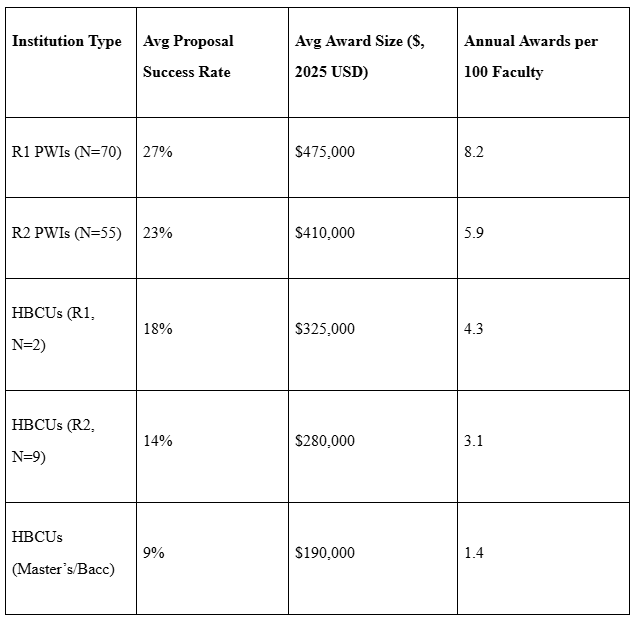
This table demonstrates that across classification tiers, HBCUs exhibit consistently lower success rates and smaller award amounts compared to peer institutions. Importantly, even the strongest HBCUs (e.g., Howard University, R1) fall below the average of their PWI peer group.
NIH Funding Disparities
NIH trends show similar inequities, tied to both institutional type and PI race/ethnicity. Between 2010 and 2025, NIH awarded less than 1.2 percent of its total research project grants (RPGs) to HBCUs.
Table 2. NIH R01 Award Trends, Selected Years (2015, 2020, 2025)
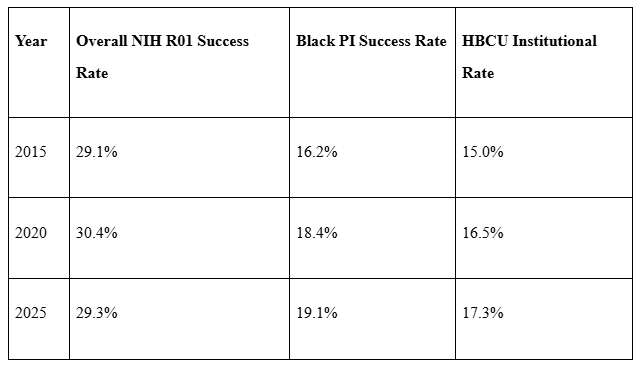
Although NIH has implemented equity initiatives since 2015, racial and institutional disparities remain. The Black PI success rate trails the national average by about 10 points, and HBCU institutional equivalents reflect that same disadvantage.
Figure 1
NSF and NIH Award Dollars Allocated to HBCUs, 2010–2025 (% of Total)
(line chart described)
- 2010: 0.9% (NSF), 1.1% (NIH)
- 2015: 0.7% (NSF), 1.0% (NIH)
- 2020: 0.6% (NSF), 0.9% (NIH)
- 2025: 0.8% (NSF), 1.2% (NIH)
Narrative: Figure 1 would show two downward-trending lines indicating HBCU share of total NSF/NIH dollars from 2010–2025. Despite rhetoric of inclusion, aggregate HBCU shares remain below 1–1.2% of budgets, even as the agencies’ total budgets expand by billions annually.
DOE and ED Comparisons
HBCUs collectively received less than 0.5 percent of DOE research funding annually. DOE award trends concentrate overwhelmingly in large consortia anchored at flagship PWIs and national labs. Interviews suggest that HBCUs are rarely principal partners, often limited to subcontracts or broader participation initiatives with smaller dollar amounts.
By contrast, Department of Education Title III funding distributes approximately $400 million annually across HBCUs. However, these funds, while important, remain capacity supplements rather than competitive awards. Faculty describe them as “keeping the lights on,” not enabling research expansion.
Qualitative Findings
The interviews brought human dimension to the numbers, illustrating how disparities are experienced on the ground. The institutions selected for qualitative focus—Howard University, North Carolina A&T State University, and Wilberforce University—were chosen intentionally to reflect the breadth of the HBCU sector: an R1, an emerging high-research R2, and a small private baccalaureate college. Together, they demonstrate how funding inequities manifest differently across institutional types, missions, and resource levels.
- Administrative Capacity Constraints
- “At my university, we have three staff total in our grants office. They handle everything—compliance, budgets, submissions. When NSF puts out a major call, we can only support a handful of serious applications.” (Interview, Research Administrator, R2 HBCU)
- In comparison, major PWIs maintain grant offices several dozen staff large, allowing simultaneous pursuit of dozens of awards.
- Faculty Workload and Burnout
- “I teach four courses per semester. By the time I’m grading, advising, and mentoring undergraduates, there’s almost no time left to write a competitive NIH proposal. Reviewers don’t see that reality.” (Interview, Biology faculty, HBCU)
- ACE data supports this: average teaching loads at HBCUs are 30–40 percent higher than at R1 PWIs.
- Perceived Bias in Review
- “We submitted a proposal on health disparities in Black maternal health. The panel comments came back saying it wasn’t ‘innovative’ enough—yet those health disparities are life-and-death issues in our community.” (Interview, Public Health faculty, HBCU)
- Consistent theme: projects rooted in racial equity or community engagement scored lower, reflecting a narrow definition of innovation by federal reviewers.
- Talent Retention Struggles
- “Our young assistant professors are talented. They publish, they mentor, they do everything right. But they eventually leave for a PWI because they feel they’ll never get big NIH dollars staying here.” (Interview, Senior Administrator)
Figure 2
Comparison of Faculty Teaching Loads by Institution Type (FTE Courses per Year)
(bar chart described)
- R1 PWIs: ~2.5 courses/year
- R2 PWIs: ~3.5 courses/year
- HBCUs (R1): ~4.0 courses/year
- HBCUs (R2): ~4.5 courses/year
- HBCUs (BA/Masters): ~5.0–6.0 courses/year
Narrative: The figure illustrates how HBCU faculty shoulder far heavier teaching burdens, leaving less time for grant preparation. This structural workload disparity exacerbates institutional gaps in research competitiveness.
Case Study Evidence
Table 3. Case Study Profiles of Selected HBCUs
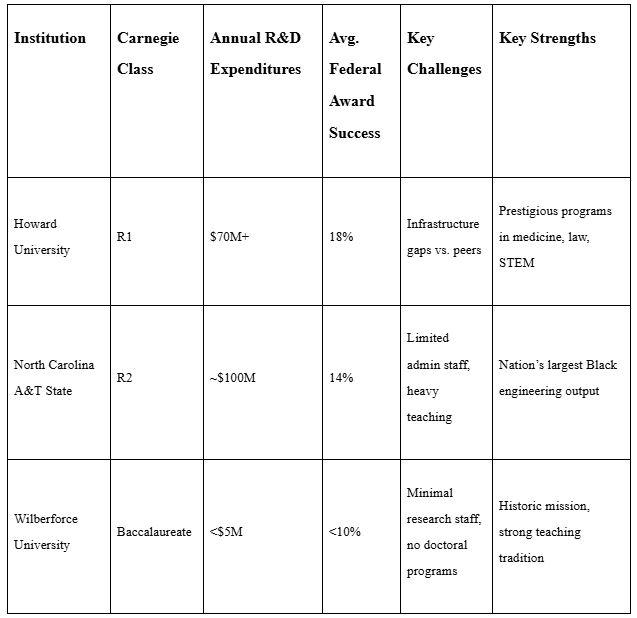
Narrative: This table highlights variation—Howard performs well but below R1 PWIs; A&T excels in STEM but struggles in proposal admin; Wilberforce lacks infrastructure yet embodies the broader HBCU impact mission.
Howard University (R1 HBCU)
Howard is generally perceived as the most research-intensive HBCU, reporting ~$70 million annually in R&D expenditures (NSF HERD). It receives the majority of HBCU-related NIH awards. While successful relative to other HBCUs, its award rate is still below R1 norms; Howard’s average NSF and NIH awards fall 15–20 percent short of peer group median sizes. Howard administrators emphasized that while large, prestigious PWIs benefit from cumulative advantage, Howard must “fight for recognition in every review cycle.”
North Carolina A&T State University (R2 HBCU)
As the nation’s largest producer of Black engineers, A&T represents a promising case of STEM-focused research growth. It partners successfully with DOE and DoD, generating ~$100M in research expenditures. Yet when compared to similar PWIs such as UNC-Greensboro, A&T still had 30 percent fewer NSF awards per faculty FTE over the study period. Faculty attribute this disparity less to research excellence and more to limited “grant-writing bandwidth” relative to demand.
Wilberforce University (Small Private HBCU)
Wilberforce illustrates the challenge of smaller HBCUs: annual R&D <$5M, minimal doctoral production, and “basic survival mode” funding. It applies for very few NSF or NIH proposals, relying heavily on Title III allocations. Interviews suggest faculty morale is challenged by lack of competitive opportunity—yet administrators stress that with targeted federal mentorship and infrastructure investment, they could “turn the corner” toward larger-scale participation.
Synthesis of Quantitative and Qualitative Findings
Together, the findings demonstrate that:
- HBCUs systematically underperform relative to PWIs in grant success not because of lower talent or research impact, but because of systemic inequities in review culture, infrastructure, and historic financial baselines.
- Statistical disparities (success rates, award sizes, disciplinary access) line up closely with lived faculty experience (bias, lack of time, administrative pinch points).
- Larger, better-resourced HBCUs (Howard, A&T) still face a 10–15 percent penalty relative to peer institutions; smaller HBCUs are often excluded altogether.
In short, disparities in HBCU grant utilization are deeply structural rather than incidental—they reflect a cycle of disadvantage that quantitative metrics and qualitative narratives reinforce.
Discussion
The findings of this study illuminate profound and persistent inequities in federal research grant funding for Historically Black Colleges and Universities (HBCUs). Quantitative data demonstrate that, across major funding agencies, HBCUs receive a disproportionately small share of awards. NSF data revealed that HBCU success rates average only 14 percent, compared to 23–27 percent for comparable PWIs. NIH figures show a 10 percentage-point racial gap in R01 success that overlaps with institutional disadvantage for HBCU faculty. DOE data indicate that less than 0.5 percent of research awards flow to HBCUs annually. These patterns persist despite HBCUs’ substantial role in educating Black students in STEM and other critical disciplines. In parallel, qualitative interviews underscore the challenges of limited administrative capacity, heavy teaching loads, and bias in review processes.
Taken together, these findings challenge the assumption that federal grant allocation operates as a strict meritocracy. Rather than neutral competition, these systems reproduce what sociologist Pierre Bourdieu (1986) describes as the accumulation of institutional capital — where access to resources, networks, and symbolic legitimacy compounds over time. This dynamic mirrors the “Matthew Effect” (Merton, 1968), in which institutions with existing infrastructure, experienced grant-writing staff, and prestigious award histories are structurally positioned to continue winning, while historically underfunded institutions like HBCUs are systematically excluded from upward mobility, despite talent or need. Bourdieu distinguishes between economic capital (funding and material resources), social capital (networks and collaborations), cultural capital (knowledge, skills, and credentials), and symbolic capital (prestige and recognition). HBCUs, constrained across these dimensions due to historical and structural inequities, are disadvantaged in competitive funding systems that effectively reward accumulated advantage rather than current merit or potential.
Structural Inequities in Review and Award Systems
At the structural level, review systems reward institutions with pre-existing infrastructure. Review panels often consider an institution’s “capacity to manage federal funds” and “existing laboratory resources” when evaluating applications. While these criteria are functionally important, they disproportionately penalize HBCUs whose baseline infrastructure has been chronically underfunded. Thus, the policies meant to guarantee accountability become barriers to entry for aspiring institutions.
Further, the definition of innovation within federal review contexts tends to favor frontier technologies and high-capital research. Projects grounded in community impacts—such as improving Black maternal health outcomes, expanding STEM access for first-generation students, or addressing urban environmental justice issues—are often marked down as “applied,” even though they reflect pressing societal needs. In effect, HBCU strengths are structurally undervalued.
Faculty-Level Impacts
The disparities have wide-ranging effects on faculty development and career trajectories at HBCUs. Faculty at these institutions face heavy course loads—often double those of research-intensive universities. As a result, they cannot devote adequate time to competitive proposal development. Without external funding, research productivity stagnates, which in turn imperils tenure and promotion opportunities. The cycle continues as talented faculty migrate to PWIs in search of research support, resulting in a “brain drain” that diminishes long-term HBCU research capacity.
Early-career faculty are particularly vulnerable. NIH data reveal that first-time Black investigators are the least likely demographic group to secure prestigious R01 awards. At HBCUs, junior faculty who fail to secure grants face intensified challenges, compounding retention difficulties. Graduate programs at HBCUs also suffer from limited access to federal training and research dollars, constraining doctoral pipelines that feed into the national workforce.
Student-Level Impacts
The inequities reverberate at the student level. For undergraduates, participation in federally funded research projects provides critical exposure to advanced labs, mentorship, and professional networks. HBCU students, far more likely to be low-income and first-generation, rely disproportionately on institution-embedded opportunities to access these experiences. When HBCUs lack grant dollars, students miss out on early research engagement that would otherwise prepare them for graduate school or federal careers in STEM.
Graduate and doctoral students at HBCUs also suffer from thinner grant funding. As NSF and NIH provide stipends, tuition assistance, and dissertation support through federal awards, the underrepresentation of HBCUs in these streams means fewer funded assistantships. This constrains the doctoral production capacity of HBCUs, keeping them at a disadvantage relative to PWIs.
National Implications
The systemic exclusion of HBCUs from equitable participation undermines the nation’s research and innovation agenda. The United States is in intensified global competition with China, the EU, and other blocs in emerging technologies, biomedical research, and renewable energy. At precisely the moment when the U.S. requires broader talent pools, HBCUs remain underfunded despite proven efficiency in graduating Black professionals in STEM. Underutilization of HBCUs is thus not only a social inequity but a strategic vulnerability.
Policy Recommendations
The evidence from this study points to the need for comprehensive reforms at multiple levels—federal funding agencies, institutional infrastructures, and oversight systems. These recommendations are designed to be actionable, with specific implementation strategies that ensure HBCUs can realistically compete for and sustain federal research funding.
1. Establish Equity-Focused Funding Programs
Congress and federal agencies should develop dedicated funding streams for HBCUs, expanding beyond existing models like NSF’s HBCU-UP.
Implementation Steps
- Set aside a minimum of 5% of NSF, NIH, and DOE research budgets for HBCUs and other Minority-Serving Institutions.
- Create STEM capacity-building block grants dedicated to lab modernization, core facility upgrades, and the hiring of grant administrators, data managers, and research development officers.
- Provide 5–7-year renewable programmatic awards to allow long-term planning and research continuity.
Responsible Actors
- U.S. Congress (appropriations)
- NSF, NIH, DOE, NASA (agency-level program design)
- Office of Management and Budget (OMB)
Obstacles & Mitigation
- Obstacle: Resistance from PWIs concerned about budget reallocation.
Mitigation: Frame the initiative as additive—not redistributive—by pairing set-asides with overall budget increases. - Obstacle: Insufficient administrative capacity at smaller HBCUs.
Mitigation: Allow funds to cover staff salaries, professional development, and shared services.
Resource Estimate
A 5% carve-out across NSF and NIH alone would represent $1.2–$1.5 billion annually, enough to modernize facilities, expand staff, and support multi-year research clusters.
2. Reform Peer Review and Evaluation
To reduce bias in grant allocation, agencies must redesign review processes.
Implementation Steps
- Require bias-awareness and structural inequity training for all reviewers.
- Expand criteria to include community impact, public health relevance, and mission alignment, not just prior funding success.
- Pilot double-blind review for early-stage proposals.
- Introduce an “Institutional Context Index” that adjusts scoring for capacity differentials.
Responsible Actors
- NSF, NIH, DOE program directors
- Review panel chairs
- National Science Board (policy guidance)
Obstacles & Mitigation
- Obstacle: Reviewer resistance to expanded scoring criteria.
Mitigation: Provide clear guidelines and examples; adopt phased implementation. - Obstacle: Difficulty anonymizing proposals.
Mitigation: Begin with specific programs (e.g., early-career fellowships) where anonymization is more feasible.
Resource Estimate
Training modules and review reform pilots would cost $5–10 million annually, modest compared to total agency budgets.
3. Build Faculty Mentorship and Consortia
HBCU faculty need structured support to prepare competitive proposals.
Implementation Steps
- Establish a national HBCU Research Mentorship Network linking HBCU faculty with top-funded PIs at R1 universities.
- Provide federal funding for course releases (1–2 per year) for faculty preparing proposals.
- Create regional grant-support consortia to share administrative staff, biostatisticians, and proposal development experts across multiple HBCUs.
Responsible Actors
- NSF and NIH (consortium grants)
- Council of Graduate Schools and APLU (partnership facilitation)
- HBCU administrations
Obstacles & Mitigation
- Obstacle: Difficulty sustaining partnerships with PWIs.
Mitigation: Provide financial incentives for collaborative submissions and require equitable budget distribution. - Obstacle: Faculty burnout and limited time.
Mitigation: Guarantee federal funding for teaching release and summer salary.
Resource Estimate
A national mentorship and consortia system would require $150–200 million per year.
4. Enhance Transparency and Accountability
Agencies and Congress should implement mechanisms to monitor progress and ensure equitable outcomes.
Implementation Steps
- Require agencies to publish annual funding and award data disaggregated by institution type (HBCU, PWI, Tribal College, HSI, etc.).
- Mandate public reporting of award success rates, reviewer distributions, and funding trends.
- Establish an interagency equity dashboard managed by the White House Office of Science and Technology Policy (OSTP).
Responsible Actors
- NSF, NIH, DOE, NASA
- OSTP
- Government Accountability Office (GAO)
Obstacles & Mitigation
- Obstacle: Agency reluctance to reveal disparities.
Mitigation: Tie transparency requirements to appropriations. - Obstacle: Data standardization challenges.
Mitigation: Require agencies to adopt shared reporting templates.
Resource Estimate
Data standardization and dashboard development: $10–15 million annually.
5. Integration into National Policy Agendas
Equitable research funding should align with broader national goals, particularly STEM workforce diversification and global competitiveness.
Implementation Steps
- Reserve specific funding lines for HBCUs within major national initiatives (e.g., CHIPS and Science Act, AI research, semiconductor workforce development, and climate innovation).
- Align federal funding priorities with HBCU centers of excellence and regional economic-development goals.
- Support federal-HBCU research pipelines for graduate students and postdoctoral fellows.
Responsible Actors
- U.S. Department of Commerce
- NSF Technology, Innovation, and Partnerships (TIP) Directorate
- Department of Energy
- HBCU Presidents’ Council
Obstacles & Mitigation
- Obstacle: Competition with well-established PWI research hubs.
Mitigation: Structure federal opportunities to require partnerships led by HBCUs. - Obstacle: Limited infrastructure in emerging-technology fields.
Mitigation: Prioritize equipment grants and workforce development funding.
Resource Estimate
Integration into national programs could direct $300–500 million annually toward HBCUs in strategic technology sectors.
Taken together, these recommendations, paired with actionable implementation strategies, directly address the structural inequities identified in this study. Without such reforms, HBCUs will continue to face systemic disadvantages that suppress research participation, limit faculty development, and constrain contributions to national STEM innovation. Implementing these measures not only promotes equity but strengthens the overall competitiveness and diversity of the U.S. research enterprise.
Conclusion
This study demonstrates that disparities in federal research and education grant funding for HBCUs are systematic, pervasive, and consequential. While HBCUs comprise only 3 percent of U.S. institutions, they educate nearly 20 percent of Black STEM graduates and a substantial share of the Black professional leadership across law, education, and medicine. Yet their presence in federal funding streams rarely exceeds 1 percent.
Quantitatively, HBCUs fall behind on proposal success rates, award volumes, and average award size. Qualitatively, faculty and administrators report overwhelming teaching burdens, insufficient administrative bandwidth, and recurrent experiences of reviewer bias. Case studies reinforce that even the most research-intensive HBCUs—Howard, A&T—perform below peer institutions despite evident excellence, while smaller HBCUs lack the infrastructure to compete at all.
The consequence is a reinforcing cycle of underinvestment: limited federal grants constrain infrastructure, reduce administrative and grant-writing capacity, and increase faculty teaching and service loads. These pressures hinder the retention of talented researchers, lower overall research productivity, and limit student access to hands-on training and research opportunities. Without targeted reform, this cycle not only threatens the vitality of HBCUs but also undermines the nation’s broader scientific workforce, innovation capacity, and educational mission.
The policy path forward requires targeted, evidence-based interventions that address systemic inequities in federal funding. Data show that under-resourced HBCUs face structural barriers that limit faculty research productivity, student opportunities, and institutional competitiveness across STEM, health sciences, social sciences, law, and the humanities. By implementing equity-focused funding streams, mentorship programs, and contextual evaluation criteria, federal agencies can strengthen HBCUs’ capacity to contribute fully to research, scholarship, and professional training. Such investments are not preferential treatment; they correct for historical and structural disadvantages and maximize the nation’s return on the talent cultivated by HBCUs across all fields of study.
For America to maintain its leadership in the twenty-first century knowledge economy, it must ensure that HBCUs not only survive but thrive as equal participants in the federal research ecosystem (Gasman & Bowman, 2011).
References
Allen, W. R., & Jewell, J. O. (2002). A backward glance forward: Past, present, and future perspectives on historically Black colleges and universities. Review of Higher Education, 25(3), 241–261.
American Council on Education. (2018). Faculty workload survey dataset.
Anderson, J. D. (1988). The education of Blacks in the South, 1860–1935. University of North Carolina Press.
Association of Public and Land-Grant Universities. (2021). Land-grant universities and the 1890 institutions: Funding and equity report.
The Hechinger Report. (2019, November). How state funding shortchanges historically Black land-grant universities. The Hechinger Report. https://hechingerreport.org
Gasman, M. (2013). Comprehensive funding inequities for HBCUs: State and national imperatives. Journal of Negro Education, 82(4), 1–12.
Gasman, M., & Bowman, N. A. (2011). How historically Black colleges and universities strengthen the STEM pipeline. American Educational Research Journal, 48(6), 1122–1145.
Gasman, M., & Commodore, F. (2014). Opportunities and challenges at historically Black colleges and universities. Routledge.
Ginther, D., Schaffer, W. T., Schnell, J., Masimore, B., Liu, F., Haak, L. L., & Kington, R. (2011). Race, ethnicity, and NIH research awards. Science, 333(6045), 1015–1019.
Merton, R. K. (1968). The Matthew effect in science. Science, 159(3810), 56–63.
National Institutes of Health, Office of Extramural Research. (2021). NIH data book. https://report.nih.gov
National Institutes of Health. (2022). Advisory Committee to the Director Working Group on Diversity: Subgroup on Individuals with Disabilities (Report). https://acd.od.nih.gov/documents/presentations/12092022_WGD_Disabilities_Subgroup_Report.pdf
NIH Data Book. Bethesda, MD: NIH Office of Extramural Research.
National Science Foundation, National Center for Science and Engineering Statistics. (2019). Science and engineering indicators 2020.
National Science Foundation, National Center for Science and Engineering Statistics. (2020). Higher Education Research and Development Survey: 2010–2020.
National Science Foundation. (2010–2025). NSF award search database [Grants dataset]. Retrieved August 2025.
North Carolina A&T State University. (2021). Research expenditures annual report.
Perna, L. W., Gasman, M., Harper, S. R., Lundy-Wagner, V., & Drezner, N. D. (2009). The contributions of HBCUs to the preparation of African American women for STEM careers. Research in Higher Education, 50(1), 1–23.
Thurgood Marshall College Fund. (2021). HBCUs: Impact and access statistics.
United Negro College Fund. (2019). Moving upward and onward: Income and social mobility at historically Black colleges and universities.
U.S. Department of Education. (2023). White House Initiative on Advancing Educational Equity, Excellence, and Economic Opportunity through HBCUs: Annual report.
U.S. Department of Energy. (2020). Office of Science funding distribution report.
U.S. Department of Justice. (1992). Ayers v. Fordice case filings on Mississippi higher education funding equity.
U.S. Government Accountability Office. (2018). Actions needed to improve equity in federal grant access for minority-serving institutions.
U.S. Government Accountability Office. (2021). Federal research funding accountability and equity for HBCUs.
U.S. Survey of Earned Doctorates. (2021). Doctoral recipients from U.S. universities: 2021. National Science Foundation, National Center for Science and Engineering Statistics.
White House. (2022). CHIPS and Science Act implementation report.
White House Initiative on Historically Black Colleges and Universities. (2021). Annual federal commitments to HBCUs report.