


.jpg)
.jpg)
.jpg)
.jpg)


.svg)


.svg)

This article examines the development of Operation EPIC Fury within the broader context of escalating U.S-Israel tensions in the region. It analyzes the strategic and geopolitical stakes of the ongoing operation while turning to a deeper constitutional question: who has the authority to commit the United States to war. By exploring this live development, the War Powers Resolution, and the separation of powers framework, the piece evaluates whether modern military engagements align with America's constitutional design.
Article content
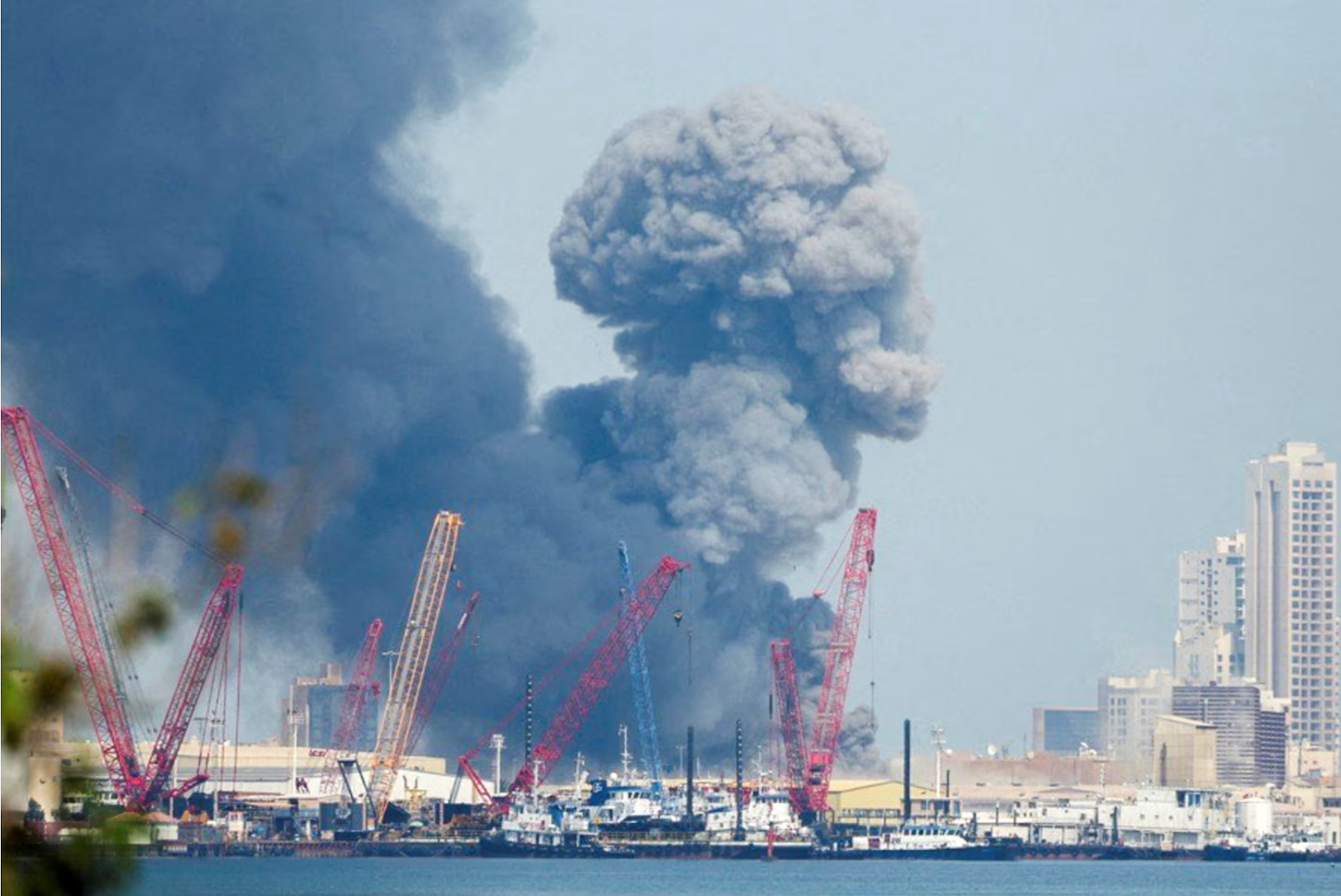
At 4:30 a.m. Pacific Standard Time, on February 28, 2026, my phone rang. Half asleep, I swiped the screen---headlines suddenly confirming it: the United States and Israel had launched coordinated military strikes against Iran.
By 5:07 a.m Pacific Standard, explosions were heard across the United Arab Emirates, Israel, U.S Bases, and Tehran among other cities. Iran had begun firing missiles in retaliation across the Middle East, with world leaders issuing urgent statements urging restraint and warning of wider escalation.
For many Americans, the news landed as if it began overnight. But in the United States, the question that follows the first strike is not only what happened, it is also who has the authority to do it, for how long, and under what oversight.
This is the civic framework most students are rarely taught to examine until it’s already unfolding in real time.
What we know so far and what is still developing
Multiple outlets including AP News, Reuters, and Bloomberg reported that Israel said it launched what is described as a pre-emptive attack against Iran, with U.S. military action accompanying Israel’s strikes. Iran, according to Reuters, warned before the escalation that it would retaliate and could target U.S bases in neighboring countries if attacked, a retaliatory threat that, by Saturday, was being reported across the region.

Israel responded by declaring a nationwide emergency posture: shuttering schools and workplaces, restricting gatherings, closing airspaces, and moving some hospital activity underground, according to Reuters.
U.S President Donald Trump sent a message touting its response to attacks on Truth Social at 2:30 a.m Eastern Time on February 28, 2026, saying the United States had launched “major combat operations” in Iran as part of an initiative Reuters identified as “EPIC FURY,” and warned American casualties were possible, but were noble for the greater cause. He framed the strikes as part of a campaign targeting Iran’s capabilities, including its nuclear program and missile-related objectives.
You can watch his full message here.
Even as military details continue to evolve, one part is stable: the legal and democratic question of how the U.S force is authorized.
The Constitutional Fight over War Powers
The United States Constitution divides war powers in a way that is intentionally uncomfortable.
- Congress has the power to declare war and control military funding (the power of the purse)
- The President is commander in chief and can direct the armed forces
That tension, speed versus oversight, becomes the most visible when hostilities begin quickly like with OPERATION EPIC FURY.
In response to past conflicts, Congress passed War Powers Resolution of 1973 which lays a basic framework: when United States armed forces are introduced into hostilities (or imminent hostilities), the President must report to Congress within 48 hours, and military action generally cannot continue beyond 60 days (with an additional 30-day withdrawal period in certain circumstances) without congressional authorization with limited exceptions.
This is where the story shifts from battlefield headlines to democratic accountability: if the United States enters sustained conflict, the next critical milestone is not only the next strike—it is what Congress authorizes, challenges, or refuses to endorse.
Why the War Powers Debate Matters More than it Sounds
A common assumption is that “war” begins only when Congress declares it. In practice, modern U.S military action often begins through executive decision-making moving into political and legal debate afterwards.
That matters for students for three reasons:
First: duration. The War Powers framework is built around the reality that military actions expand faster than democratic deliberation. The 48-hour reporting requirement and the 60-day clock exist because history has shown how quickly “limited” operations can widen and escalate.
Second: accountability. Even if a president argues a strike is necessary for national security, to protect Americans, or to counter terrorism, oversight determines whether the action undertaken becomes a sustained U.S commitment. That oversight isn’t abstract, it is in votes, hearings, appropriations, and legal constraints that shape what happens next.
Third: consequences beyond the region of conflict. Expanded conflict affects U.S priorities at home: federal spending choices, political stability, energy markets, and how safe Americans feel in an increasingly connected world.
The Nuclear File, and Why Timing Matters
This escalation comes amid heightened international focus on Iran’s nuclear posture with its growing arsenal. On February 27, 2026, Reuters reported that the U.N. nuclear watchdog (IAEA) issued a report urging Iran to allow inspections and pointing to heightened concern around sites including Isfahan.
This matters because arguments over military action are often tied to nuclear risk, one side frames strikes as prevention, the other argues escalation increases danger, instability, and civilian harm. Global reaction has already reflected that divide.
What students should watch next
If you want to follow this like a civics story, not just a breaking news feed, watch for signals that determine whether this becomes a short-term strike cycle or a longer U.S engagement:
- Formal War Powers notifications to Congress (and how lawmakers respond).
- Whether Congress considers specific authorization for force, restrictions, or funding limits.
- International diplomatic moves at the U.N. and among regional states reacting to retaliation and airspace disruptions.
- Verification of claims about targets and damage as independent reporting catches up to the speed of events.
A Final note on Media Literacy in a Fast-Moving Developing War
In the first 24-72 hours of a major escalation, misinformation spreads faster than confirmation. The most responsible way to stay informed is to separate what is verified from what is asserted, especially on social media, where emotionally persuasive content can outpace evidence.
The civic task for students is not to have the loudest opinion first. It’s to understand the system making decisions in your name, and to know what oversight is supposed to look like when stakes are this high.
Works Cited
Cornwell, Alexander. 2026. “Israel Shuts Schools, Bans Gatherings as Iran Launches Retaliatory Missiles.” Reuters, February 28, 2026. https://www.reuters.com/business/aerospace-defense/israel-shuts-schools-bans-gatherings-iran-launches-retaliatory-missiles-2026-02-28/.
Liechtenstein | AP, Stephanie. 2026. “UN Nuclear Watchdog Says It’s Unable to Verify Whether Iran Has Suspended All Uranium Enrichment.” The Washington Post. February 27, 2026. https://www.washingtonpost.com/world/2026/02/27/iran-nuclear-iaea-uranium-enrichment-suspend/95f9ad04-13e5-11f1-8e8d-fe91db44677b_story.html.
Murphy, Francois. 2026. “IAEA Report Says Iran Must Allow Inspections, Points at Isfahan.” Reuters, February 27, 2026. https://www.reuters.com/world/middle-east/iran-stored-highly-enriched-uranium-underground-site-iaea-report-says-2026-02-27/.
Press, Associated. 2026. “The Latest: US and Israel Attack Iran as Trump Says US Begins ‘Major Combat Operations.’” Boston.com. February 28, 2026. https://www.boston.com/news/politics/2026/02/28/the-latest-us-and-israel-attack-iran-as-trump-says-us-begins-major-combat-operations/.
Reuters Staff. 2026. “US and Israel Launch ‘Pre-Emptive’ Attack against Iran.” Reuters, February 28, 2026. https://www.reuters.com/world/middle-east/israel-says-it-launched-pre-emptive-attack-against-iran-2026-02-28/.
Staff, Al Jazeera. 2026. “US, Israel Launch Attack on Iran, Explosions in Israel, Gulf Arab States.” Al Jazeera. February 28, 2026. https://www.aljazeera.com/news/2026/2/28/explosions-in-downtown-tehran-smoke-seen-rising.
Stoimenova, Marina. 2026. “US and Israel Launch Strikes on Iran – What Has Happened so Far.” Euronews. euronews.com. February 28, 2026. https://www.euronews.com/2026/02/28/us-and-israel-launch-strikes-on-iran-what-has-happened-so-far.
Zablocki, Clement J. 1973. “H.J.Res.542 - 93rd Congress (1973-1974): War Powers Resolution.” Www.congress.gov. November 7, 1973. https://www.congress.gov/bill/93rd-congress/house-joint-resolution/542.


.jpg)
